
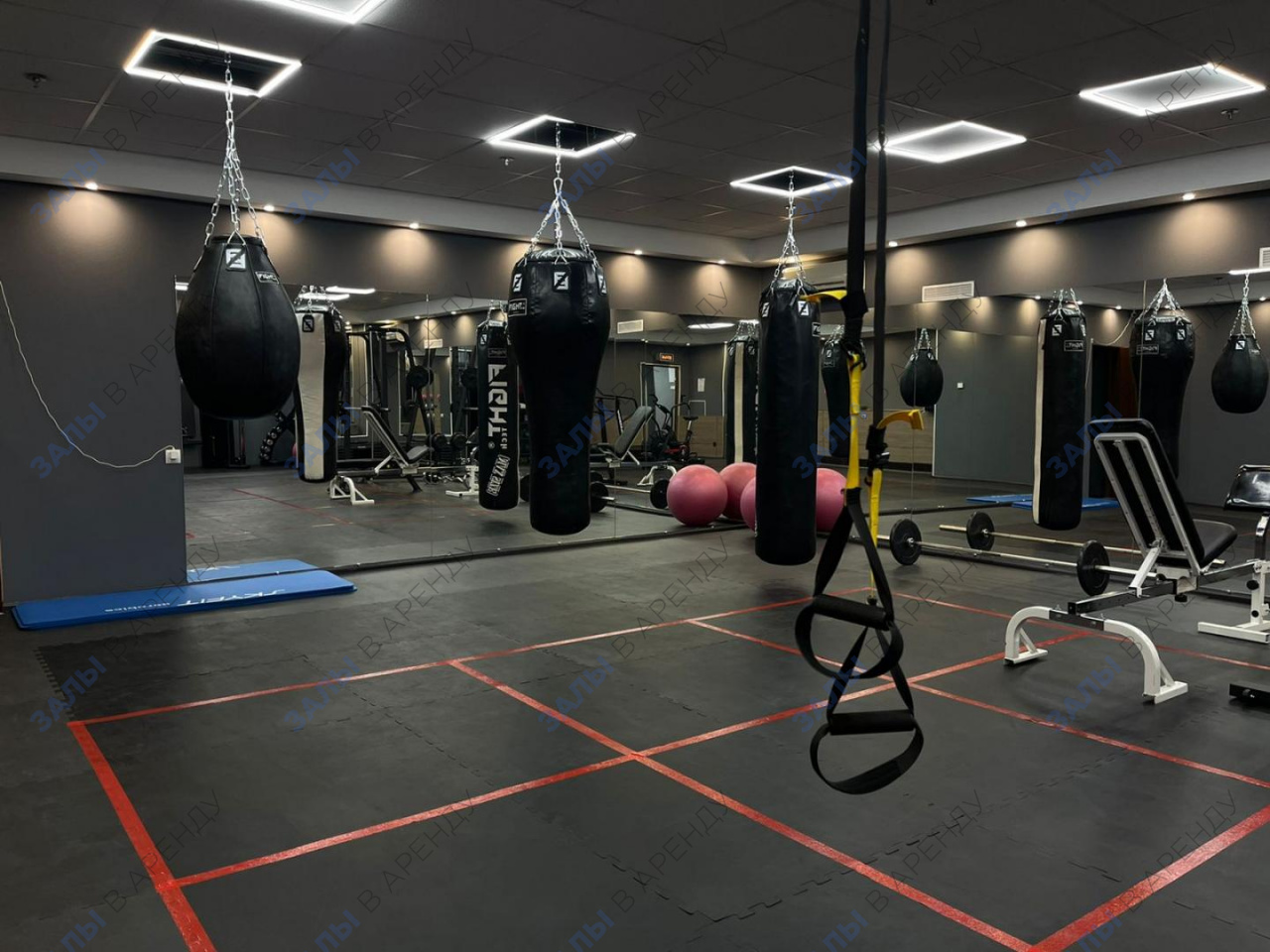
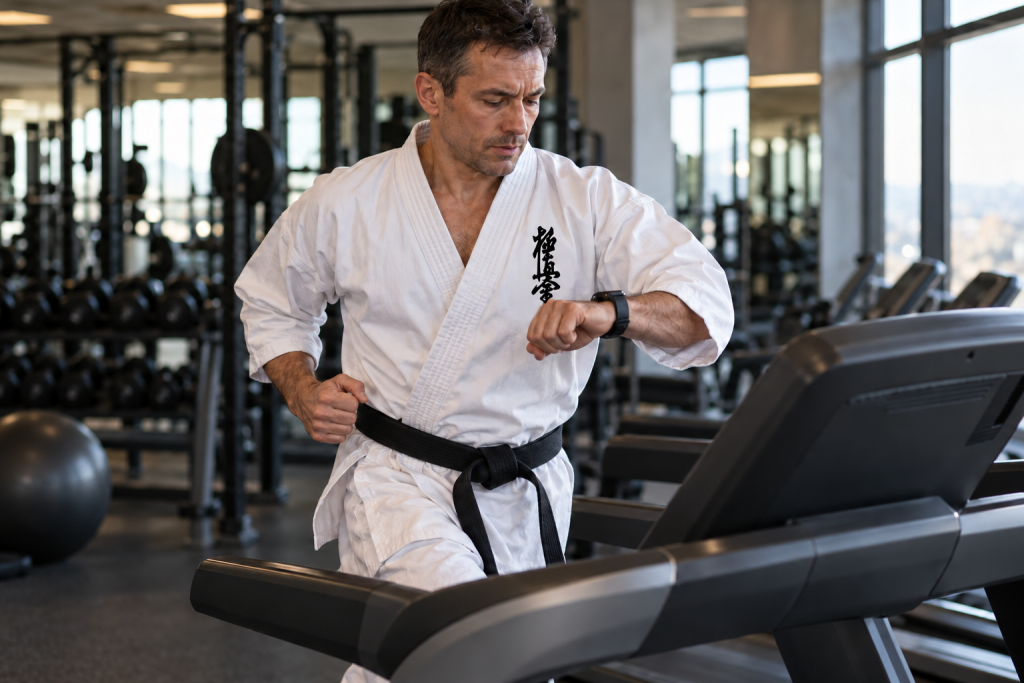
The question of whether you can train at a gym alongside Kyokushin comes up for most fighters sooner or later. Some fear gaining extra mass and losing speed, others have heard that «weights kill flexibility,» and others simply want to get stronger but are not sure how to avoid hurting their karate. Let’s look at this honestly — from a physiology standpoint and through the practical lens of experienced coaches.
What Physiology Says
Strength training and combat sports develop different energy systems and different types of muscle fiber. In the gym you primarily work slow-twitch fibers (with high-rep exercises) or fast-twitch fibers (with heavy loads and low reps). Kyokushin demands both types, but in a different ratio: a strike is an explosion lasting 0.1-0.2 seconds, while kumite is 2-3 minutes of variable intensity.
The main physiological trap is called «interference of training effects.» When you are aggressively building muscle mass (hypertrophy), the body shifts resources toward protein synthesis and building new muscle structures. Fewer resources remain for refining the neuromuscular patterns — speed, coordination, precision — that karate technique requires. Put simply, the body cannot simultaneously build a «warehouse» and teach that «warehouse» to operate at explosive speed.
In addition, hypertrophy without speed work genuinely slows strikes: the muscle gets bigger, but the nervous system does not have time to re-tune the fiber recruitment pattern to explosive mode. The result — a fighter who looks more powerful but moves slower in a bout.
This does not mean «don’t go to the gym.» It means: go the right way.
How Gym Training Affects Strike Speed
Strike speed depends not on absolute muscle strength but on the speed of the nerve impulse and intermuscular coordination. Research by sports physiologists shows: strength gains through hypertrophy only improve strike speed when training includes an explosive component. If someone bench presses slowly for 8-10 reps three times a week, over time their strike becomes not faster but heavier and slower.
By contrast, exercises with moderate weight performed at maximum speed (plyometrics, explosive squats, medicine ball throws) improve strike speed noticeably. The muscle learns to «fire,» not to «push.»
How Gym Training Affects Kumite Endurance
The classic gym protocol — 3-5 sets, 2-3 minutes of rest, low heart rate between sets — transfers poorly to fight endurance. Kumite demands aerobic-anaerobic endurance: a heart rate in the 160-180 bpm range, fast recovery between exchanges, and tolerance for lactate.
High-volume strength training suppresses the aerobic system if it is not balanced with cardio. A fighter who spent the entire preparation phase in the iron gym will start «gasping» by the end of the third round — not because of weakness, but because mitochondrial density and muscle capillarization have not increased.
What a Karateka Should Avoid in the Gym
- Bulking programs with a caloric surplus and a hypertrophy focus. Extra kilograms mean an extra weight category at competition and extra stress on the joints during kicks.
- Isolation exercises as the foundation of a program: curls, pec-deck flyes, leg extensions. They create imbalanced loading and do not build patterns useful in a fight.
- Strength training to failure the day before a hard karate session or before competition. DOMS (next-day muscle soreness and stiffness) is incompatible with technical practice.
- Heavy bench press as a priority. Horizontal pressing develops the pec major through a movement pattern that is almost never used in Kyokushin. Meanwhile, tight chest muscles restrict shoulder mobility and the speed of hand strikes.
- Neglecting mobility. If there is no 10-15 minutes of stretching and joint mobility work after strength training, technique will start to deteriorate within months due to muscle shortening.
What Actually Works: Exercises and Principles
Basic compound movements at moderate weight: squats (regular and front), deadlifts, bent-over rows or dumbbell rows, pull-ups, overhead press. These build a strength base without creating muscle «isolates.»
Explosive exercises: jumps with or without a barbell, kettlebell snatches, medicine ball wall throws and floor slams, explosive push-ups with hand lift-off. These are the ones that transfer to strike speed — the body learns to «fire» force rather than accumulate it.
Core exercises as a kinetic chain, not just «abs»: instability planks (TRX, Swiss ball), rotational cable or medicine ball exercises, dead bugs, spider-man planks. A karate strike starts at the hips and travels through the torso — a weak or stiff core breaks that chain.
More pulling than pushing. Back muscles, rear deltoids, and rhomboids maintain posture and power the return of the arm after a strike. In most athletes these are weaker than the pushing muscles, and this is exactly where strength work pays direct dividends.
Rep ranges. Not 10×3 at one pace. More useful: 5×3-5 with an emphasis on explosiveness (lift as fast as possible, lower slowly) or 15-20 reps with light weight at maximum tempo.
Why CrossFit Works Better Than Traditional Gym Training for a Karateka
There is no marketing here — this is a physiological argument. CrossFit by its structure solves the same problems a fighter faces:
Metabolic conditioning (MetCon). CrossFit rounds of 8-20 minutes at variable intensity train exactly the energy system that runs in kumite. Heart rate spikes, and the body learns to recover quickly between efforts.
Functional movements under load. Thrusters, snatches, throws — these are multi-joint explosive movements through a full range. They simultaneously build strength, coordination, and endurance without splitting the program into «chest today, legs tomorrow.»
No hypertrophy specialization. CrossFit protocols are not designed to grow mass — they are designed to build work capacity. The fighter gets stronger without gaining weight.
Short rest between exercises. Getting used to working under accumulated fatigue is exactly what is needed in the final minutes of a hard bout.
The optimal combination schedule: 2-3 CrossFit sessions per week plus 3 karate sessions, with strength days not placed the day before sparring or important technical work. At least 24 hours between the gym (or CrossFit) and karate.
Conclusion
Combining Kyokushin and strength training is not only possible but advisable — professional fighters always do it. The question is not whether to combine them, but which program to choose.
Classic mass-building gym work hurts a karateka: it slows strikes, overloads recovery, and does not build the right kind of endurance. CrossFit or functional strength training with explosive exercises helps: it adds power without sacrificing speed, trains endurance in a genuine combat pattern, and builds the body as one integrated system rather than a collection of separate muscles.
The rule is simple: in the gym, train movement — not muscle. Do that, and the gym will work for your karate rather than against it.

Comments (0)
Leave a comment
Comments are moderated and published after review