
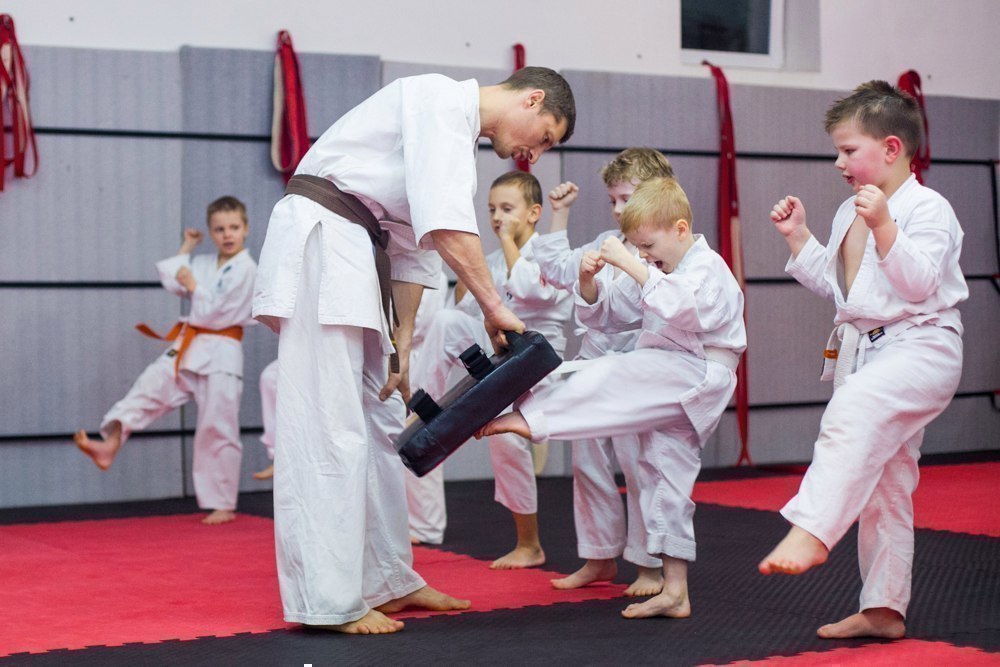
Parents bring their child to a martial arts club with the same questions every time: will it make them aggressive, is a contact style dangerous, what will they gain beyond knowing how to fight. Here are the answers in order.
What happens to the body
Kyokushin loads the body symmetrically. In tennis or soccer, one side works more than the other; in karate, stances, strikes, and kata are performed equally on both sides, so the muscular corset develops evenly. For a schoolchild who sits at a desk for half the day, this matters more than it might seem: the deep muscles of the back and core support the spine without constant reminders to «sit up straight.»
Children train barefoot. The foot works without the cushioning of a sneaker, the small muscles of the arch are strengthened, and this is effective prevention of flat feet.
Ages 6-10 are what physiologists call the sensitive period for coordination: what an adult takes months to learn, a child picks up in weeks. Balance, reaction, sense of distance, the ability to control one’s body in motion — these are established right now and stay for life, whatever sport the child chooses later. The same applies to flexibility: the splits at age 7 are a matter of months; at 17 they are a matter of years.
Will they become a bully
Usually the opposite happens, and there is a reason for it. Aggression is fueled by two things: unspent energy and the desire to test oneself. The dojo addresses both. The child gets a place where hitting is allowed — but only on command, in protective gear, according to rules, and under the coach’s eye. Aggression does not disappear; it becomes manageable. Children quickly learn: fists are for the mat, and conflicts at school are resolved with words, because there is nothing left to prove there.
There is another side to this. A confident child stops being an easy target. Bullies unfailingly pick on those who are afraid, and a child who has spent a year in sparring is noticeably less afraid — and that shows in their posture and gaze.
Character: how it actually works
Sports psychologists call this «measured stress.» The first sparring, the first belt exam, the first time stepping onto the mat in front of spectators — each of these events is frightening, manageable, and ends with the experience of «I did it.» A child who has overcome fear ten times in the dojo will be less anxious during a math test than classmates: the skill of pulling oneself together under stress transfers.
The belt system does what school rarely manages: it turns a distant goal into a chain of short ones. The black belt is years away, but the next exam is a few months of concrete work with clear requirements. This builds the habit that later gets called «able to follow through on what they start.»
A word about losses. In kumite you cannot win every time, and the child learns the most important lesson sport can teach: a defeat is information, not a verdict. Lost, analyzed the mistakes with the coach, corrected them, went back out. Adults who were not given this skill in childhood acquire it expensively and painfully.
Respect for elders — not just a ritual
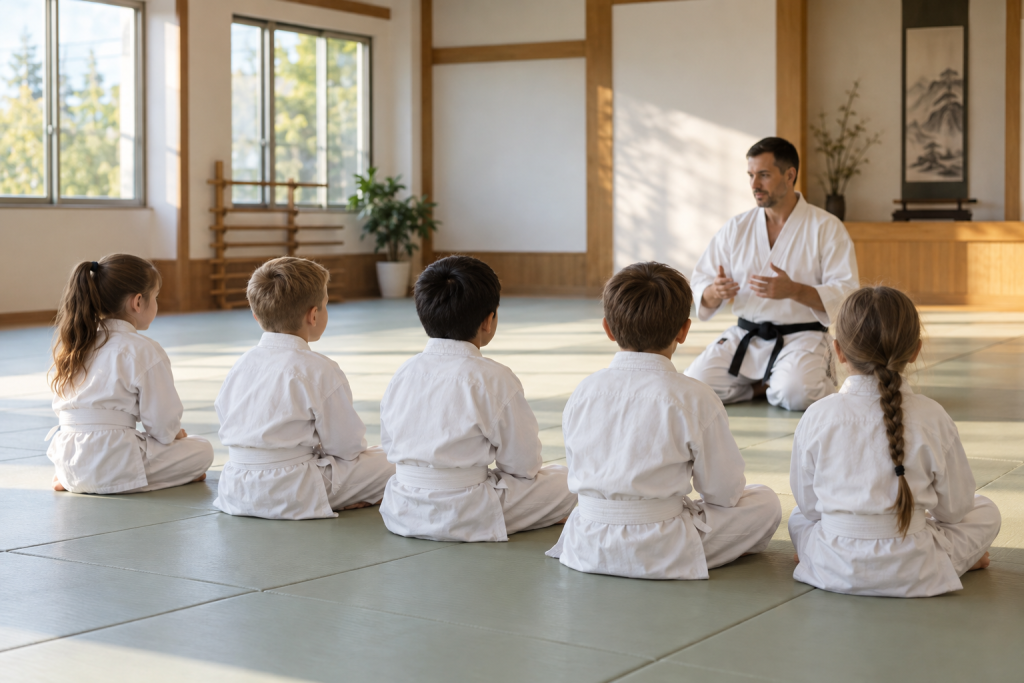
Bowing when entering the dojo, saying «Osu!» in response to the coach, the rule of not interrupting a senior belt — from the outside it looks exotic, but it is cleverly designed. In the dojo, respect cannot be demanded; it can only be earned: the sempai (senior student) earned their belt through hard work, and the junior students see that. The child absorbs not «obey because an adult said so» but «experience and effort deserve respect.» This framework transfers to teachers and parents on its own, without lectures. Coaches regularly hear the same thing from mothers: after a few months of training, the child started listening the first time.
The hierarchy works in the other direction too: once the child earns a higher belt, they become sempai to the beginners and for the first time are responsible for someone other than themselves. Showing a junior an exercise, spotting them, encouraging them — this is a mentorship experience at age ten.
What will remain when they grow up
Even if the child does not become a competitive athlete, they will enter adult life with a set of qualities that work in any profession: the habit of regular effort, composure in conflict, the ability to lose and keep going, a healthy back, and endurance. People who know how to fight fight the least — they have nothing to prove. And the habit of bowing to the place that taught you something, in adulthood, becomes a rare quality: gratitude to teachers.
Starting age and what to expect
Beginner groups accept children from age 5-6: there is plenty of game-based exercise, general physical conditioning, and basic technique. Full training with kumite starts later; contact is introduced gradually and only in protective gear.
An honest warning: after 3-4 weeks almost every child will want to quit — the novelty effect will have worn off and the real work will have begun. This is a normal crisis, not a sign that «it is not for them.» Let them reach their first belt exam: the first officially earned result usually changes their attitude to training. The first lasting changes — posture, composure, routine — are noticed by parents after about six months of regular sessions.

Comments (0)
Leave a comment
Comments are moderated and published after review