Breathing is a skill that directly affects both the power of your strikes and how quickly you gas out. The classic beginner mistake is striking while holding your breath or breathing rapidly and shallowly through the chest. The result: less power and running out of steam by the middle of the round. Kyokushin has precise breathing methods, and modern physiology explains exactly why they work. Let’s bring it all together — from the doctor’s side and the coach’s side.
Breathe from Your Belly, Not Your Chest
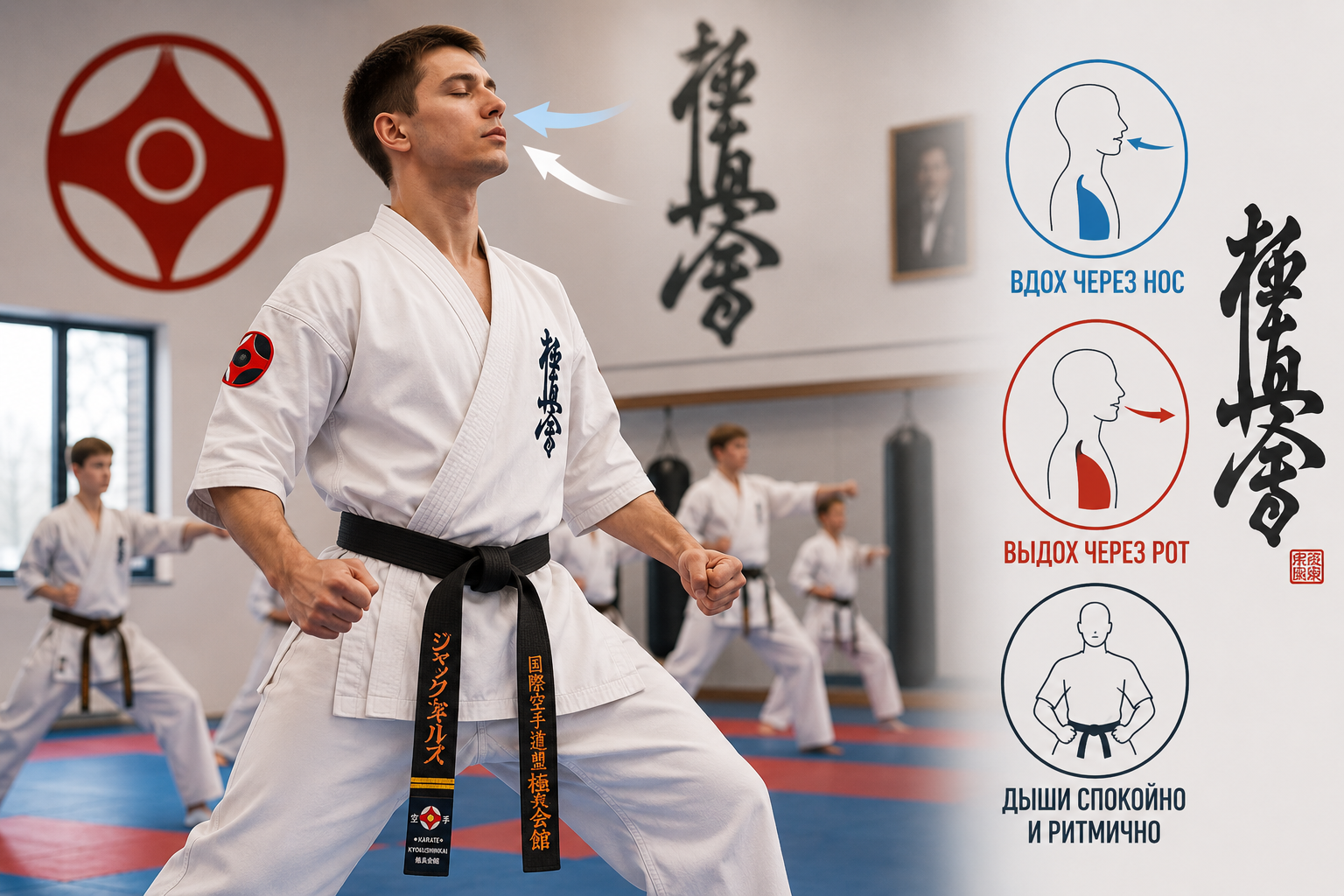
The foundation of everything is diaphragmatic (belly) breathing. When you breathe from your belly, more air enters the lungs, oxygen is absorbed more efficiently, and your heart rate stays lower. Shallow chest breathing does the opposite: you tire faster and lose core stability. Learn to breathe from the belly at rest before transferring it into movement.
Exhale on Effort — Never Hold Your Breath
The key rule: a sharp exhale with every strike and every burst of effort. In Kyokushin this is ibuki — a powerful, controlled belly exhale synchronized with technique — and kiai — a shout on the decisive strike. This is not ritual: exhaling while tensing the core delivers more power and protects the body. Physiology confirms this from the other direction — striking while holding your breath (the Valsalva maneuver) sharply raises blood pressure and risks dizziness and loss of consciousness. A brief breath-hold is appropriate only for a single maximal effort, not as a habit during striking or cardio work. The rule is simple: never strike on a held inhale.
Between Rounds — Long Exhale Through the Nose
To recover your heart rate quickly, Kyokushin uses nogare — quiet, gentle nasal breathing with no tension. The mechanism is this: inhaling slightly speeds up the heart, exhaling slows it down. So make the exhale longer than the inhale, calmly, through the nose — this activates the parasympathetic system and drops your heart rate within seconds. What not to do: rush or overdo it — hyperventilation flushes out carbon dioxide, causes dizziness, and actually worsens oxygen delivery to the muscles.
Nose or Mouth?
During light to moderate intensity work, technical drilling, and recovery — breathe through the nose: efficiency is higher and perceived fatigue is lower. At peak intensity, in hard kumite, breathing through the mouth is necessary — you need the air volume. Don’t force yourself to breathe only through the nose when working at maximum effort.
Sanchin — A Breathing Machine
The Sanchin kata is, in essence, breathing training under tension: a controlled ibuki exhale coupled with intense muscular engagement. This deliberate practice carries over into fighting — breathing becomes automatic. The takeaway is simple: breathing needs to be trained specifically and intentionally, not left to sort itself out in sparring.
Bottom line: correct breathing is applied physiology, not tradition for its own sake. Exhale on the strike (ibuki and kiai), calm nasal exhale for recovery (nogare), belly over chest. Master these and you will add power to your strikes and stop gasping by the end of the round.

Comments (0)
Leave a comment
Comments are moderated and published after review