This article is for informational purposes only and does not replace a medical consultation. Before starting training with a confirmed scoliosis diagnosis, you must obtain a written assessment from an orthopedist or vertebrologist specifying permissible activity levels.
What Scoliosis Is and Why It Matters
Scoliosis is a lateral curvature of the spine in the frontal plane, often accompanied by rotation (twisting) of the vertebrae. According to international orthopedic associations (SRS — Scoliosis Research Society), idiopathic scoliosis affects 2-3% of the population; in the majority of cases it is diagnosed between the ages of 10 and 16 during the period of active skeletal growth.
The degree of scoliosis is measured by the Cobb angle — the angle between the end vertebrae of the curve on an X-ray:
- Grade I — up to 10 degrees: functional changes, muscle imbalance; no restriction of physical activity is required.
- Grade II — 10-25 degrees: structural changes in the spine; monitoring and corrective exercises are needed.
- Grade III — 25-40 degrees: significant deformity, often with changes to the chest wall; physical activity strictly as prescribed by a doctor.
- Grade IV — more than 40 degrees: severe deformity, often requiring surgical treatment; contact sports are contraindicated.
The critical point: Grade I-II scoliosis, with a properly selected workload, is not a contraindication to sport. This is confirmed by guidelines from the American Academy of Pediatrics (AAP) and the Scoliosis Research Society: children with scoliosis under 20 degrees can participate in all forms of physical activity without restriction, provided they are under regular orthopedic supervision.
Physiology: How the Muscles and Spine Function With Scoliosis
With scoliosis, the back muscles are in a state of chronic asymmetric tension: muscles on the convex side of the curve are overstretched and weakened, while those on the concave side are shortened and overloaded. This is called muscle imbalance, and it is simultaneously a consequence of scoliosis and a factor in its progression.
Intervertebral discs in scoliosis experience uneven axial loading: one edge of the disc is compressed more, the other is stretched. Over time this leads to degenerative changes, especially when vertical impact loading or twisting without neutral spinal stabilization is added.
The good news: a strengthened muscular corset — the rectus and oblique abdominal muscles, spinal extensors, multifidus, and quadratus lumborum — reduces the load on the discs and partially compensates for the deformity. That is precisely why therapeutic exercise for Grade I-II scoliosis focuses on strengthening the core rather than immobilizing the spine.
What in Kyokushin Is Beneficial for Scoliosis
Part of Kyokushin training overlaps with what orthopedic doctors prescribe for scoliosis:
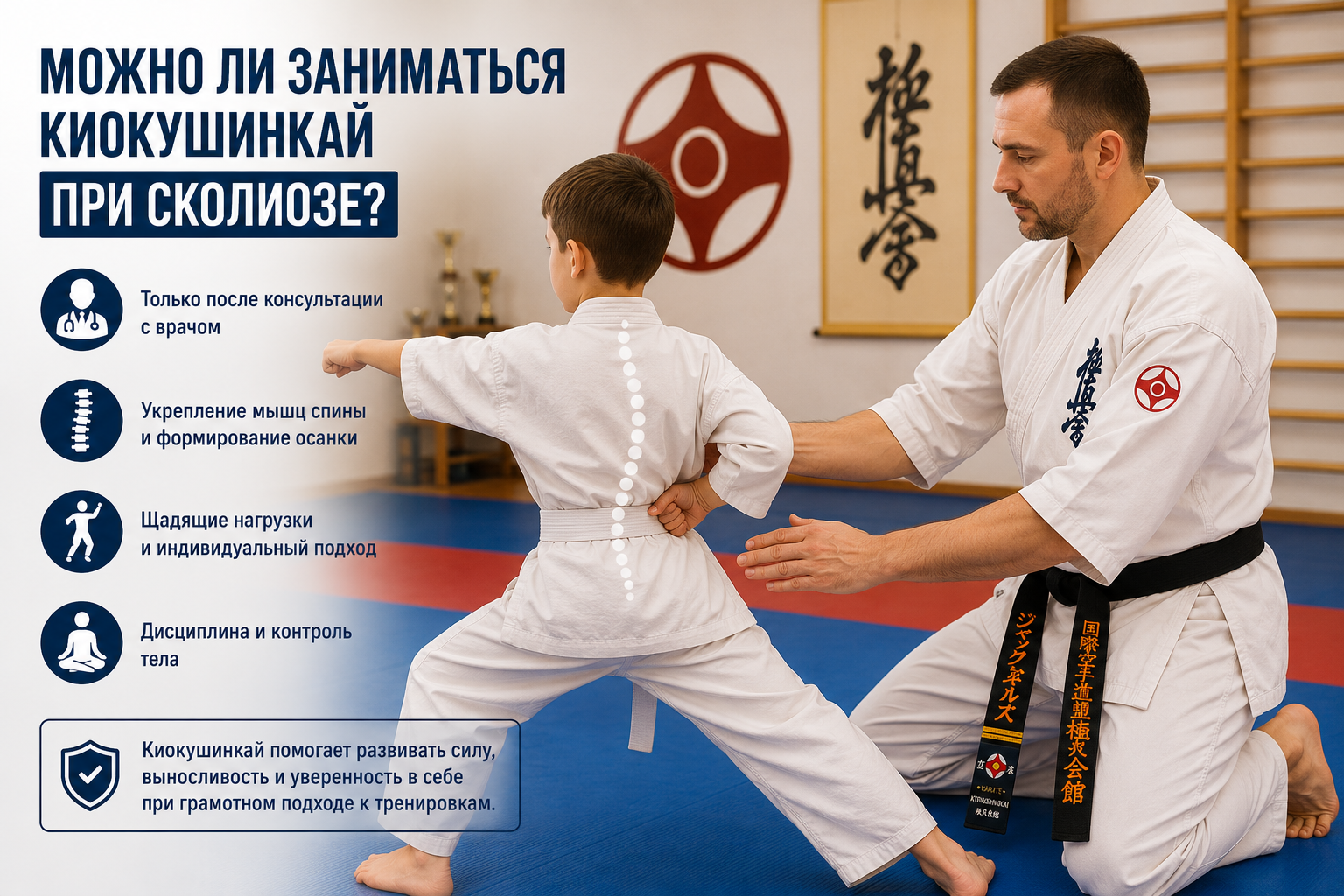
Strengthening the spinal stabilizer muscles. Basic stances (fudo-dachi, zenkutsu-dachi), kata, and balance work constantly engage the deep core muscles. This is exactly the group that must be developed in any degree of scoliosis.
Symmetrical loading. Most basic Kyokushin techniques are performed on both sides alternately — unlike, for example, tennis or throwing events, where one side dominates. Symmetrical loading does not aggravate the asymmetry characteristic of scoliosis.
Body position awareness. The coach constantly corrects posture, stance, shoulder alignment, and hip position. For a child with scoliosis this provides extra practice in kinesthetic body awareness — one of the key elements of physical rehabilitation.
Stretching without axial loading. Warm-up and cool-down include flexibility exercises that relieve muscle tension and improve joint mobility — beneficial for chronic muscle imbalance.
What Is Contraindicated or Requires Restriction
With Grade II scoliosis and above, certain elements of the training process require caution or exclusion:
Axial impact loading on the spine. Jump drills with hard landings and high-volume skipping rope work create vertical disc compression. Their volume should be limited for Grade II-III scoliosis.
Loaded spinal rotation. Rotational trunk movements with resistance (weighted twists, partner throws with rotation) place additional torque on already rotated vertebrae. Rotational techniques without load (stance turns, kata) are permissible for Grade I-II.
Extended kumite at Grade III. A contact bout is an unpredictable environment — body strikes, falls, grabs, sudden accelerations. At Grade III, this creates a risk of additional injury to vertebral arches and facet joints. The decision on whether to allow kumite at Grade III rests solely with an orthopedic doctor.
Spinal extension exercises under load. The «bridge,» deep back bends with bodyweight, and push-ups at the extreme end of spinal extension increase lumbar lordosis and compression on the concave side of the curve in scoliosis.
Training during periods of active growth with progressive scoliosis. If the Cobb angle increases by 5 degrees or more over 6 months of observation, this is active progression. During this period the doctor may restrict all loading until stabilization.
What the Coach Needs to Consider
The coach does not diagnose or prescribe treatment — but they see the child several times a week and notice things a parent may miss.
Request a medical certificate specifying clearance and the degree of scoliosis. The phrase «the child has a slight scoliosis» is not actionable information. You need to know the grade, the direction of the curve, and whether the orthopedist has specified any restrictions.
Notice asymmetry in stances and movement. If one shoulder is consistently higher than the other, the hips are uneven, or stances look clearly different on the right and left sides — this calls for a conversation with the parents, not aggressive correction of «stand properly.»
Do not force flexibility toward the side of the curve. If the scoliotic curve goes to the right, forced stretching to the right does not correct it — that is a job for a physiotherapy specialist. The coach should not try to «fix» scoliosis through stretching.
Reduce impact loading volume when the child complains of back pain. Pain is a stop signal. Working «through back pain» with scoliosis is unacceptable. If a child complains of spinal pain after training, the next step is a conversation with the parents and referral to a doctor — not «push through it, it’s just your muscles.»
Monitor loading during growth spurts. Between the ages of 10 and 14, the spine grows most actively, and scoliosis is more likely to progress at this age. During periods of active growth, impact loading on the spine should be dosed more carefully.
The Psychological Aspect
Children with scoliosis often receive the message «you can’t» from school and home. The orthopedist says «limit activity,» the PE teacher excuses them from class, the parents forbid them to run. Accumulated over time, this experience builds an avoidant relationship with their own body and with sport.
From a sports psychology perspective, excluding a child with Grade I-II scoliosis from physical activity causes more harm than properly organized training. According to qualitative research (Negrini et al., 2018, Scoliosis and Spinal Disorders), children who continued to engage in sport with moderate scoliosis under specialist supervision showed better psycho-emotional outcomes and a higher quality of life than those whose physical activity was restricted.
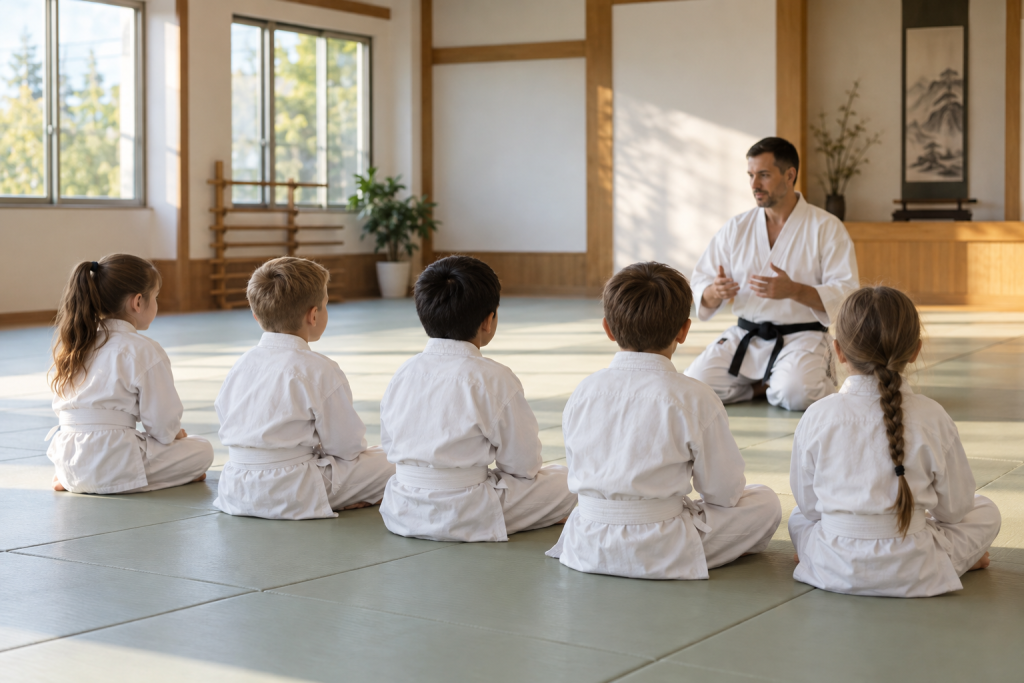
A dojo where a child with scoliosis feels like a full participant — not a «special case» — does more for their self-confidence than any number of supportive conversations.
Summary: Who Can Train, Who Needs Care, Who Cannot
| Degree of Scoliosis | General Conclusion | Special Conditions |
|---|---|---|
| Grade I (up to 10 degrees) | Can train without restriction | Regular orthopedic check-up once a year |
| Grade II (10-25 degrees) | Can train following recommendations | Limit axial impact loading and loaded rotation; kumite — by agreement with the doctor |
| Grade III (25-40 degrees) | Only with written clearance from an orthopedist | Kumite and jump work prohibited without explicit medical approval |
| Grade IV (more than 40 degrees) | Contact sport is contraindicated | Only therapeutic exercise and specialized rehabilitation are appropriate |
The key principle remains unchanged: scoliosis is not a reason to give up sport, but a reason to approach it mindfully. A doctor’s clearance, an honest conversation with the coach, and attention to your body’s signals — these three conditions make Kyokushin training with Grade I-II scoliosis beneficial rather than harmful.
Comments (0)
Leave a comment
Comments are moderated and published after review