«Hyperactive» is a word parents and teachers often use to describe any high-energy child. But from a psychological and neurobiological standpoint, hyperactivity is not simply excess energy — it is a specific pattern of brain function with well-understood mechanisms and well-understood consequences. It is worth understanding this before enrolling a child in any sports section, and especially in a contact sport.
What Hyperactivity Is: Psychology and Physiology
In clinical practice hyperactivity is considered within the framework of Attention Deficit Hyperactivity Disorder (ADHD). According to WHO data, ADHD occurs in 5-7% of school-age children and is one of the most thoroughly studied neurodevelopmental disorders. It is not a disciplinary problem or «poor upbringing» — it is a feature of how the frontal lobes of the cerebral cortex function, the area responsible for executive functions: impulse inhibition, planning, sustained attention, and behavioral control.
Neuroimaging research (Castellanos et al., 2002; Shaw et al., 2007) showed that in children with ADHD, maturation of the frontal-parietal cortical zones is delayed by an average of 2-3 years compared to neurotypical peers. A deficit of dopaminergic and noradrenergic transmission in the reward and attention systems has also been recorded — this is the source of difficulties sustaining motivation for «boring» tasks.
In practice this looks like: the child does not «refuse» to sit still — their nervous system is experiencing a stimulation deficit and compensates with motor restlessness. They find it objectively harder to inhibit impulsive reactions and switch between tasks. Intelligence, as a rule, is not affected.
Three presentations are distinguished: predominantly inattentive (without pronounced hyperactivity), predominantly hyperactive-impulsive, and combined. The last is most common.
What Life Is Like for Such a Child
The main difficulties for hyperactive children are not that they don’t understand the rules, but that they find it harder to follow them in real time. This plays out at three levels:
- Attention — hard to hold focus on a task that offers no immediate reward; easily distracted by external stimuli.
- Impulsivity — they react before they’ve had time to think; hard to «insert a pause» between stimulus and response.
- Motor control and self-regulation — constant motor restlessness as a form of self-stimulation; difficulties with waiting, turn-taking, and accepting refusal.
In an academic setting this leads to conflicts. In a physically active setting — to success, if the workload is properly structured.
Why Movement Works Like Medicine
Physical activity affects the same neurotransmitter systems as pharmacological treatment for ADHD. A meta-analysis by Vysniauske et al. (2020), published in the Journal of Attention Disorders, showed: regular physical training reliably improves attention, working memory, executive functions, and reduces hyperactivity in children with ADHD. Even a single aerobic session improves executive functions for 60-90 minutes afterward.
The mechanism: physical exertion raises dopamine and noradrenaline levels in the prefrontal cortex — exactly the neurotransmitters whose deficit underlies ADHD symptoms. In effect, training is not just «letting off steam» but a temporary neurochemical correction.
But not all sports are equally effective. Team games with unpredictable dynamics provide high loads but do not require sustained impulse inhibition. Martial arts — especially those with a clear structure and rituals — work differently.
What Kyokushin Has That Other Sports Don’t
Research on martial arts and ADHD is limited but consistent. Studies by Najafi et al. (2021) and Lakes & Hoyt (2004) show: martial arts training with an emphasis on self-control improves impulse inhibition, attention, and prosocial behavior in children with ADHD significantly better than unstructured physical activity.
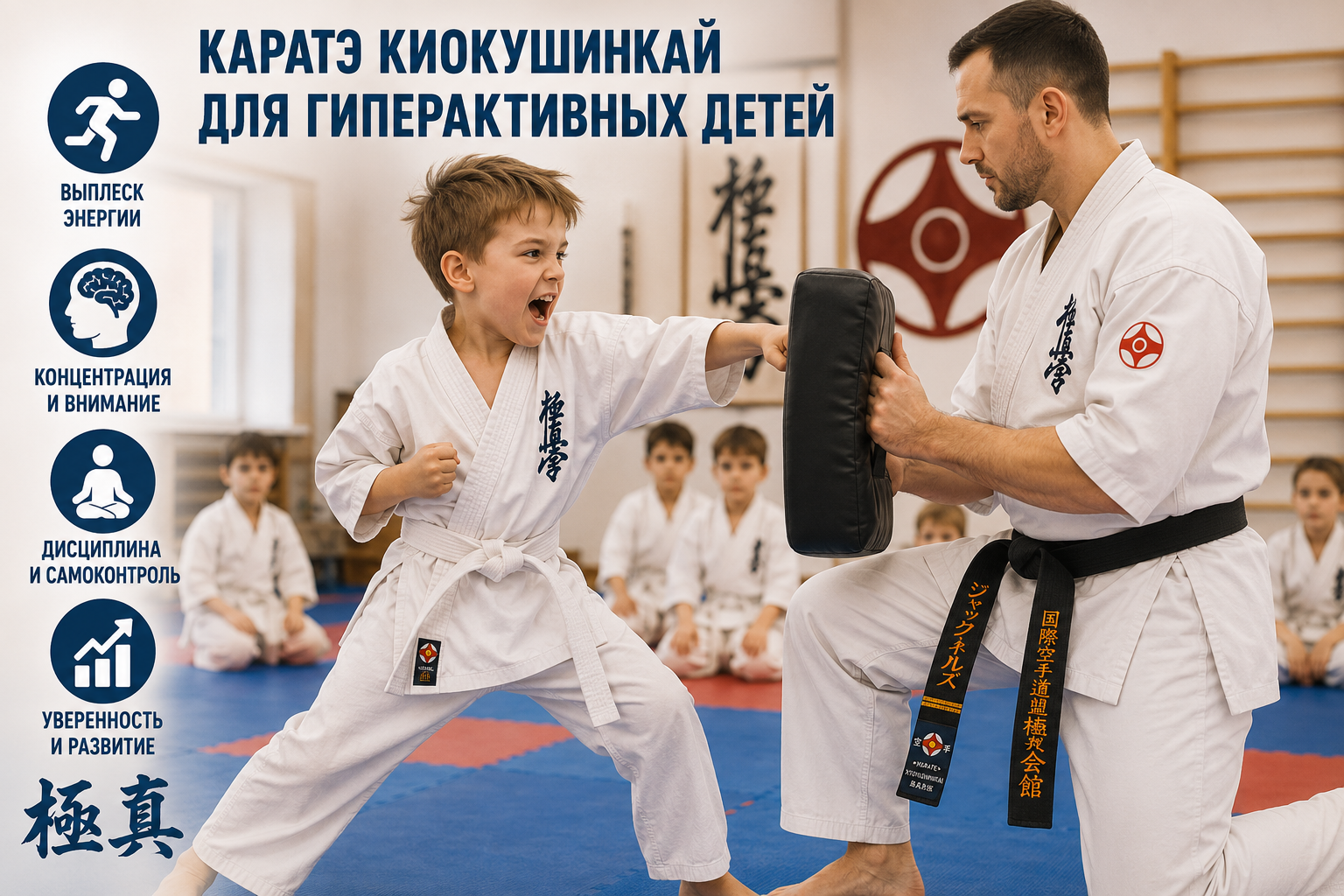
Kyokushinkai as a style has several structural features that directly address the deficits of a hyperactive child:
A clear structure for every session. Warm-up, basic technique, kata, kumite, stretching — always in the same order. For a brain that struggles with transitions, a predictable rhythm reduces cognitive load and frees up resources for learning.
Short tasks with immediate feedback. One strike — trainer’s response. One kata — evaluation. For a neural system with a short reward horizon, this is the optimal format: not «work for six months for a result» but «do it — get a response right now.»
Ritual inhibition. The bow when entering the dojo, the bow to the coach, «Osu!» as a mandatory response — these are repeatedly practiced pauses between intention and action. That very skill of impulse inhibition, which hyperactive children find hardest, is literally trained hundreds of times per session.
High-intensity physical load. Striking the makiwara, drilling combinations, circuit training — this is not light movement but real aerobic-anaerobic work, after which the dopaminergic system receives exactly the boost it needs.
A social hierarchy with clear rules. The belt system removes social uncertainty: you know exactly who is above you, who is below you, and what you need to do to advance. For an impulsive child this reduces the number of situations where they don’t know how to behave.
Possible Difficulties: An Honest Look
Not everything is straightforward, and it is important for parents to understand this.
Sparring and impulsivity. Contact sparring is a high-emotional-arousal environment. A hyperactive child with insufficiently developed inhibition may respond aggressively to being hit, continue attacking after «Yame,» or fail to stop on a referee’s command. This is not malicious intent — it is insufficient maturity of the inhibitory systems. Kumite should be introduced gradually, only after the child has learned to inhibit in a less arousing environment.
Frustration at failure. Children with ADHD often react to setbacks more intensely than their peers — this is linked to features of emotional regulation. If training feels like a series of failures, motivation drops quickly. In the first months it is important that the child receives confirmation of success more often than feedback on errors.
Long explanations don’t work. A hyperactive child literally cannot hold 4-5-step instructions in working memory. Commands must be short: one action, one command.
Medication therapy does not interfere with training. If a child is receiving pharmacological treatment (methylphenidate and similar) — that is not a contraindication to training. Some parents note that by the evening session the medication’s effect is wearing off: coaches should take this into account if the child’s behavior noticeably changes toward the end of a class.
What Coaches Should Pay Attention To
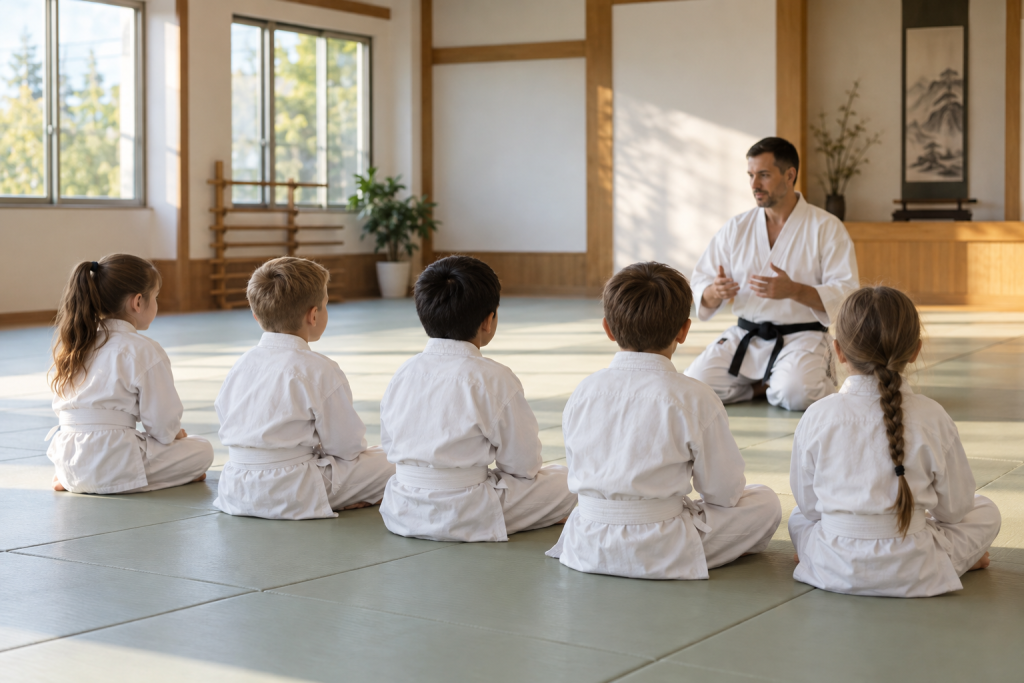
A coach working with a hyperactive child does what a good coach always does — only more consistently and deliberately:
- Give instructions briefly and concretely. Not «pay more attention» but «watch my hands.»
- Notice what is right, not only correct what is wrong. Hyperactive children are particularly sensitive to negative attention — it doesn’t correct them; it excites them further.
- Change types of activity more frequently. 10-15 minutes on one type of exercise is the limit. Then switch the task or format.
- Use physical load for self-regulation, not as punishment. «Twenty push-ups for breaking a rule» creates a negative association with movement. «Do five jumps and come back» is a tension-release tool without punishment.
- Talk to parents. Understanding whether there is an official diagnosis, whether the child is taking medication, what works at home — that is not psychologizing but practical information.
- Don’t put the hyperactive child in the role of permanent rule-breaker. If they receive corrections every session, something is wrong with the format, not just with the child.
Conclusion
Kyokushinkai suits hyperactive children not because «it’s strict there» or «they get tired out.» It suits them because its structure — high-intensity load, short tasks with immediate feedback, repeatedly practiced inhibition rituals, and a clear hierarchy — works directly on the neurobiological mechanisms that malfunction in ADHD.
A hyperactive child in the dojo is not a problem for the coach. They are a child who needs a little more structure, slightly shorter commands, and a little more positive reinforcement at the start of the journey. These small adaptations don’t change the essence of training, but they significantly change its outcome.

Comments (0)
Leave a comment
Comments are moderated and published after review