
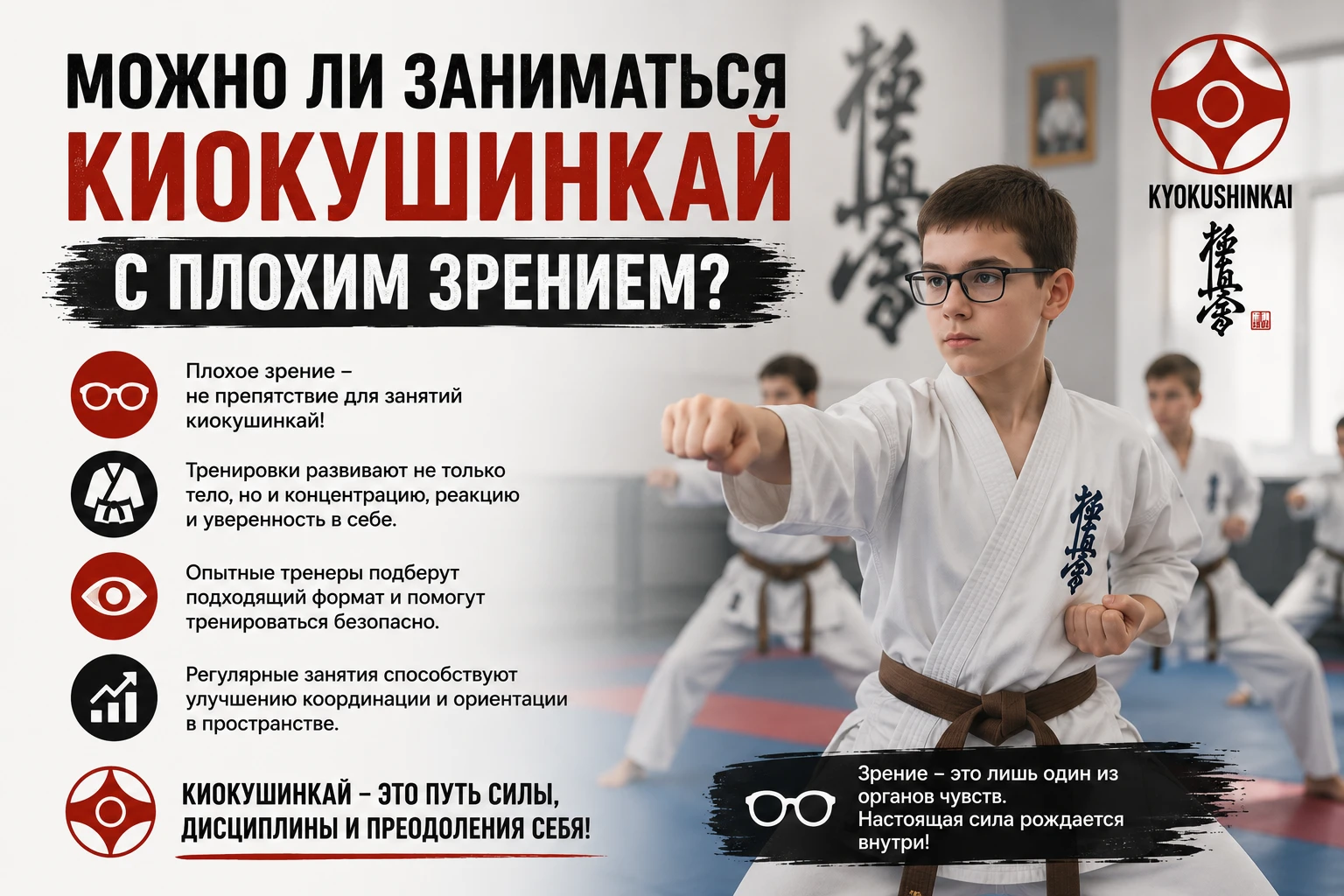
Poor eyesight is not uncommon in martial arts dojos. According to WHO statistics, myopia affects 30-40% of the population in developed countries, and a significant portion of those are people of athletic age. The question «can I train?» is better asked more precisely: for which type of vision impairment, at which severity level, and under what conditions — is training possible, and when is it not? Let’s break this down honestly, with a medical basis.
Types of Vision Impairment and What You Need to Know About Each
Myopia (nearsightedness) is the most common form. The person sees well up close but poorly at a distance. The cause: the eyeball is elongated, so the image focuses in front of the retina. Myopia is precisely what raises the greatest concern among ophthalmologists when it comes to contact sports: at high degrees (from -6 diopters and above), a thinned and pathologically stretched retina is more vulnerable to mechanical impact. A blow to the head or a sudden spike in intraocular pressure can trigger retinal detachment — one of the most serious complications, requiring urgent surgical intervention.
Hyperopia (farsightedness) — the eyeball is shorter than normal, so the image focuses behind the retina. In young people this is compensated by accommodation (tension of the lens), meaning the person may see normally both with and without glasses. At high degrees it increases the risk of angle-closure glaucoma under intense physical load, but in general hyperopia is not a contraindication to sport.
Astigmatism — an uneven curvature of the cornea or lens; the image is distorted along one meridian. It is correctable with glasses and contact lenses. In most cases astigmatism up to 3 diopters does not create specific risks for Kyokushin training when adequate correction is in place.
Amblyopia («lazy eye») — reduced visual acuity in one eye that cannot be fully corrected with glasses. In practice, the person sees only with one eye. This significantly impairs depth perception (stereopsis): judging the distance to a moving object — a strike, an opponent’s leg — becomes noticeably more difficult. With amblyopia, the question of clearance for contact sparring is decided on an individual basis.
Glaucoma — elevated intraocular pressure (IOP) that gradually damages the optic nerve. Intense physical activity, especially with straining and breath-holding, causes fluctuations in IOP. With compensated glaucoma, moderate aerobic exercise is permissible and even beneficial — it lowers IOP. Contact sports involving a risk of blows to the head are contraindicated with uncompensated glaucoma.
Physiology: How the Body Adapts to Poor Vision
A person with a chronic visual impairment from childhood develops compensatory mechanisms. Hearing becomes sharper — they detect an approaching opponent earlier. Proprioception (the sense of the body’s position in space) is better developed than in people with normal vision: the habit of not relying on visual cues trains the brain to rely more heavily on signals from muscles and joints. In balance exercises, basic technique, and kata, this can even be an advantage.
The challenges arise elsewhere. Stereopsis (depth perception) is critically important in sparring: the brain determines the distance to a moving limb by comparing the images from two eyes. When visual acuity is significantly reduced or vision is monocular, this ability is impaired — the fighter has greater difficulty judging the moment to block, the distance to a strike, or the speed at which a kick is approaching. Without correction this not only reduces the quality of performance but also increases the risk of taking a hit that a normally sighted person would have blocked.
An important distinction: training without glasses (in kata, kihon, or bag work) and training in contact kumite are fundamentally different situations in terms of visual demand and risk.
Myopia and Kyokushin: Where the Risk Is Lower Than It Seems
Unlike boxing, muay thai, or wrestling, Kyokushin has a key rule: punches to the head are prohibited. This fundamentally changes the risk calculation for people with high myopia.
In boxing, a straight punch to the head is the primary offensive weapon, and it is precisely those strikes that create a hydraulic impact of the vitreous body against the retina. In Kyokushin, head strikes are delivered only with the feet — mawashi geri, ushiro mawashi geri, yoko geri jodan. These kicks are delivered less frequently, from a greater distance, and it is generally easier to evade them through footwork than to avoid punch combinations in boxing.
That said: this does not guarantee the complete absence of head contact. The head is a legal target for kicks, and in competitive kumite they are used. For athletes with high myopia, a protective helmet during sparring is a medical necessity, not an option.
Kata, kihon, tameshiwari — parts of the training process where vision is almost not a limiting factor. For a person with moderate myopia, full participation in these disciplines is possible with both good and poor correction.
Contact Lenses and Glasses in Training
Glasses during kumite are not acceptable — they are a hazard to both participants. Contact lenses provide good visual correction but carry their own risk: an open-handed strike or accidental contact can displace a lens or press it against the cornea. Soft lenses tolerate contact sports better than hard lenses, but there is no perfect solution.
Some myopic practitioners choose laser correction (LASIK, SMILE, PRK). After surgery, ophthalmologists recommend avoiding contact sports for a minimum of 3-6 months — until the corneal scar has fully formed. LASIK creates a corneal flap that could theoretically be displaced by a blow; SMILE and PRK are considered preferable options for athletes in this regard.
What Coaches Should Watch For
- Ask the student about their degree of myopia and whether they have ophthalmological clearance. At -6 diopters and above, a certificate from an eye doctor is required stating explicitly that «contact sports — permitted».
- In kumite — a mandatory helmet for athletes with high myopia, even in practice. This is not an exception for the weak; it is a medical requirement.
- Explain to the student the warning signs to watch for: sudden flashes of light, «floaters,» or a «curtain» in the visual field after exertion — these require an immediate visit to an ophthalmologist. This may be the onset of retinal detachment.
- Account for impaired depth perception in cases of monocular vision or amblyopia: such students need more time to adapt in reaction and distance-control drills.
- Do not place a student with uncorrected vision into hard free sparring right away — without glasses or lenses, distance control is impaired, and the training partner is also exposed to unnecessary risk.
When Training Is Not Permitted
Absolute contraindications to contact training (kumite):
- Previous retinal detachment — contact sport is ruled out even after successful surgery, without a specific clearance from a retinal surgeon.
- Uncompensated glaucoma (IOP not controlled medically) — physical activity involving blows to the head and straining is contraindicated.
- Monocular vision (functional loss of vision in one eye, not correctable) — contact combat sports are generally contraindicated: loss of the second eye leads to blindness.
- Early post-operative period after retinal or corneal surgery — minimum 3-6 months without contact; the specific duration is determined by the surgeon.
- High myopia (-6 diopters and above) without an ophthalmologist’s clearance — not an absolute contraindication, but requires specialist approval with an assessment of retinal health (fundoscopy under mydriasis).
Conclusion
Poor eyesight is not a ban on karate. Myopia up to -6 diopters with a healthy retina, astigmatism, and hyperopia are not contraindications when reasonable precautions are observed. The essential condition: an ophthalmologist must examine the fundus of the eye and be aware that the person is training in a contact martial art. The coach must know about the diagnosis and have protective measures in place. And the athlete must understand the warning signs that require an immediate visit to a doctor.
In Kyokushin, the prohibition on punching to the head objectively lowers the risk for people with myopia compared to boxing or kickboxing. With a sensible approach and regular ophthalmological monitoring, training is not only possible — it is worthwhile.

Comments (0)
Leave a comment
Comments are moderated and published after review