
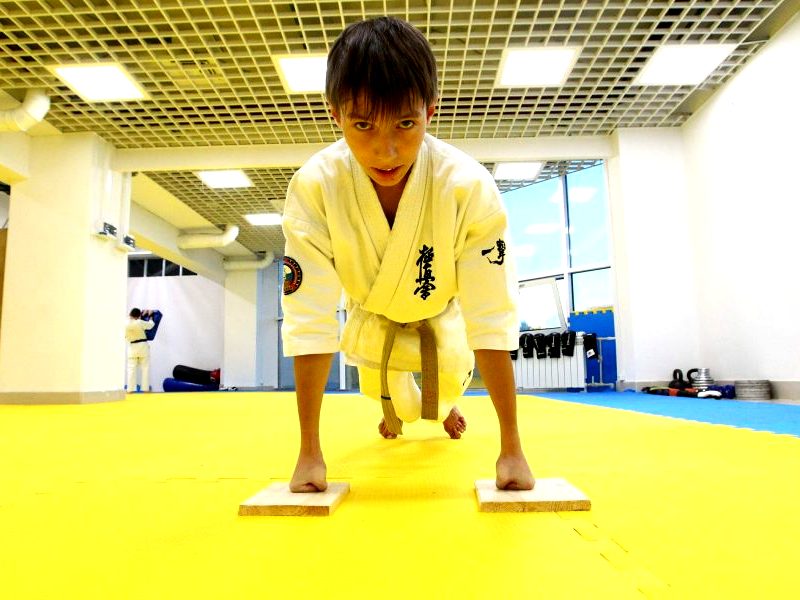
Karate training engages every muscle group in the body. Practicing karate improves flexibility, builds endurance, sharpens reaction time, and increases mobility. All of this contributes to better overall health and a longer life. Today, karate carries a stereotype of being a brutal, injury-prone sport. This perception was largely shaped by American action films and by individuals who use karate skills purely to show off physical strength.
In the mid-nineteenth century, on karate’s birthplace — the island of Okinawa — medical examinations were conducted on children. Doctors noted that children who practiced karate stood out from their peers with excellent physical conditioning and health.
In the 1980s, British scientist Craig Sharp of the University of Birmingham conducted a study involving one hundred record holders across thirty different sports disciplines. After testing for strength, agility, speed, and endurance — and measuring subcutaneous fat — Dr. Sharp concluded that the top three most «athletic» sports were ballet, gymnastics, and karate!
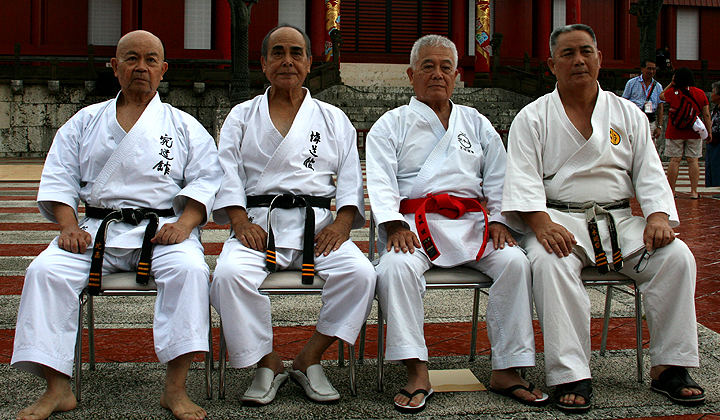
This is no surprise, given that karate training engages every muscle group in the body. Practicing karate improves flexibility, builds endurance, sharpens reaction time, and increases mobility. All of this contributes to better overall health and a longer life. According to recent research, of twenty-six of the most celebrated karate masters from the 18th to 20th centuries, twenty lived past the age of 70, eleven of them past 80, and the average lifespan was 78 years.
Yes, karate is a martial art — in a single session, many strikes are delivered, with force that can reach hundreds of kilograms. But the chance of getting injured during properly structured training is actually very low. Research into injury risk across various sports, published by the German magazine Focus, showed that karate scores significantly lower than many other popular sports in this regard. For instance, the most dangerous proved to be artistic gymnastics at 15 risk points, followed by football at 13, judo and basketball at 12 each. Karate (and boxing) scored just 10 points.
So to sum up: the rumors about the danger and brutality of karate are greatly exaggerated. On the contrary, it helps practitioners stay healthy into old age and extends their lives. We can say with full confidence that karate is not only «the art of killing» — it is also «the art of living long»!

Comments (0)
Leave a comment
Comments are moderated and published after review