
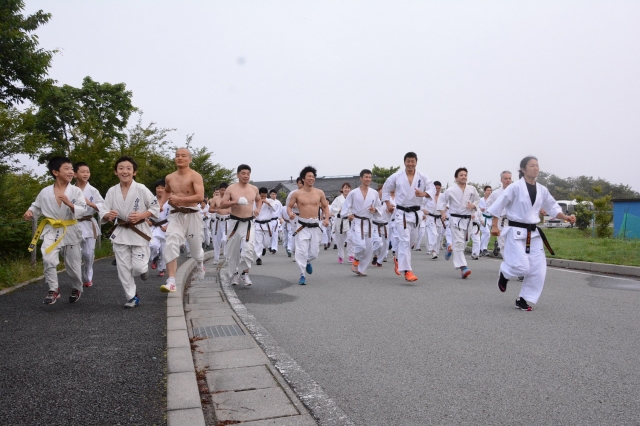
If your legs feel like lead halfway through a fight and your arms start dropping — that is not a character flaw, it is a conditioning problem. To fix it, you first need to understand which energy systems are working during kumite, and then train those systems specifically. Let’s put the physiology and coaching practice together.
Which Systems Are Active in a Fight
Kumite is an interval-style effort: short explosive exchanges alternate with rest periods (roughly one part work to one and a half parts recovery). This tells us the key point:
- The aerobic system provides the foundation — it keeps you going throughout the round and recovers you between exchanges.
- The anaerobic and phosphate (ATP-CP) systems fuel the sharp explosive actions — strikes, bursts forward, defensive reactions.
This means you need to train both: a big «engine» for endurance and the ability to produce repeated explosive efforts.
Aerobic Base — The Foundation
Steady-state cardio (running, jump rope, rowing) builds the engine that recovers you between exchanges and carries you through multiple rounds. Without this base, you will not be able to repeat explosive combinations — you will blow up after the very first one. It is the least exciting part of training, but it is non-negotiable.
Intervals (HIIT) — The Primary Specificity Tool
High-intensity interval training mirrors the structure of actual fighting, which is why it works best. Studies on karateka show gains in VO2max and anaerobic power in as little as 5-8 weeks. The format: maximal effort for 15-30 seconds, short rest, repeat. It works well in round format: timed bag or pad rounds, sprints, burpees.
Specificity — Train the Way You Fight
General cardio builds the base, but «fight conditioning» comes from work that replicates fighting: rounds, irregular tempo, sparring intervals. Endless steady-state running will not substitute for this — the body must be conditioned specifically to alternating bursts and rest.
And don’t forget recovery: endurance is not built by training to exhaustion every day, but by balancing load and rest. An overworked body does not become more resilient.
In summary: build a large aerobic base and layer intervals on top of it that match the rhythm of kumite. Train both energy systems — the explosive burst and the recovery between bursts. Do that, and by the end of a fight you will be working, not surviving.


Comments (0)
Leave a comment
Comments are moderated and published after review