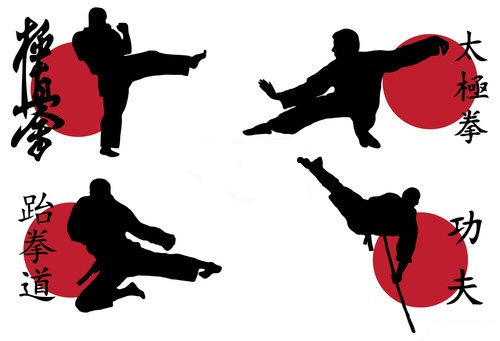
Below is a basic glossary of terms and their definitions used in Kyokushin karate.
Below is a basic glossary of terms and their definitions used in Kyokushin karate.
Short answer
Kyokushin terminology includes Japanese names for stances, strikes, blocks, commands, and kata. This glossary helps you follow training commands; confirm pronunciation and local usage with your dojo instructor.
Key points
- Learn each term together with its movement rather than as an isolated list.
- Start with the commands you hear regularly in your own training.
- Spelling and pronunciation may be transliterated differently; ask your coach about the intended meaning.
General Concepts
 Kanji — represents KyokuShinKai, where Kyoku means absolute, Shin means truth, Kai means organization, together translating as «Organization of Absolute Truth».
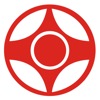 Kanku — one of the symbols of Kyokushin karate, taken from the kata of the same name, «Kanku.» In this kata, the hands are raised toward the sky and joined at the thumbs and index fingers. The points of the Kanku symbol represent the fingertips, the wide sections on the left and right represent the wrists, and the central circle symbolizes the depth and infinity of the sky. The circle behind the symbol represents continuity and circular motion.
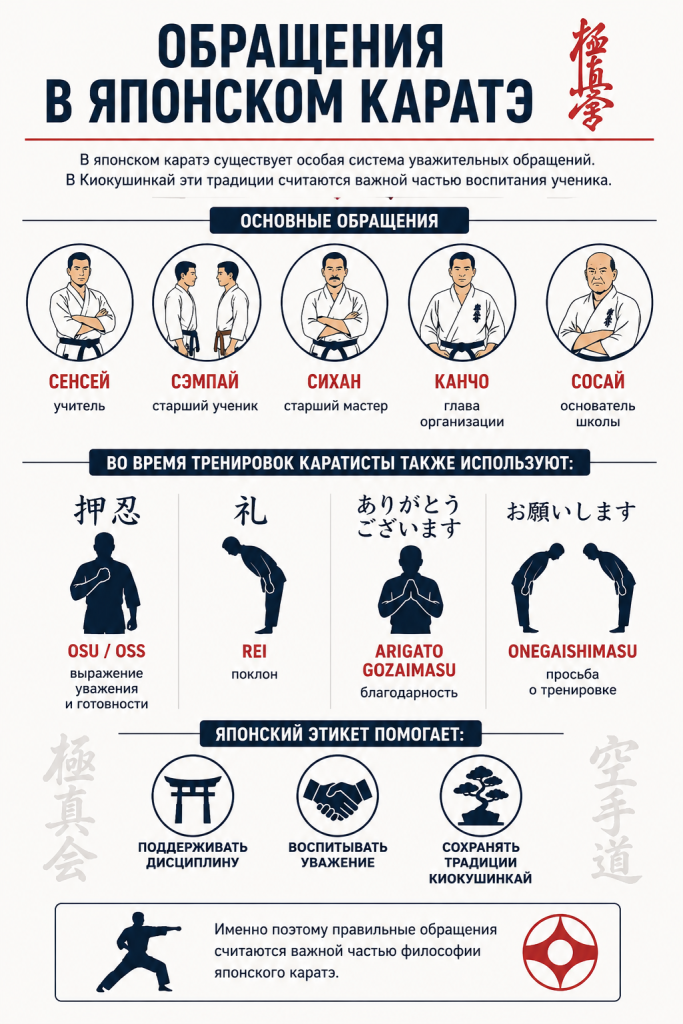
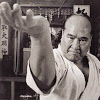 Sosai — the founder of Kyokushin karate, Masutatsu Oyama (1923-1994; the first Kyokushin karate school was opened in Tokyo in 1954).
 Shihan — a Kyokushin karate master holding 5th dan (black belt with 5 gold stripes) or above.
 Sensei — teacher; a Kyokushin karate master holding 3rd or 4th dan (black belt with 3 or 4 gold stripes).
 Sempai — senior student or instructor (typically a black belt holder).
Dojo — training hall.
Dan — master grade (black belt).
Kyu — student grade (from 10th to 1st).
Dogi — karate training uniform (often mistakenly called «kimono»).
Osu — a verbal form of greeting, agreement, and acknowledgment.
Technique
Kihon — basic technique (practiced without a partner).
Renraku — technical combinations.
Kata — formal exercise sequence.
Kumite — fighting (sparring).
Yakusoku kumite — pre-arranged sparring without a moving partner, one step at a time.
Sanbon kumite — pre-arranged sparring without a moving partner, three steps at a time.
Jiyu kumite — free sparring.
Nagare — soft breathing (gentle inhale through the nose and exhale through the mouth).
Ibuki — power breathing (quick inhale through the nose and forceful exhale through the mouth using lung strength).
Nidan — double repetition.
Sanbon — triple repetition.
Commands
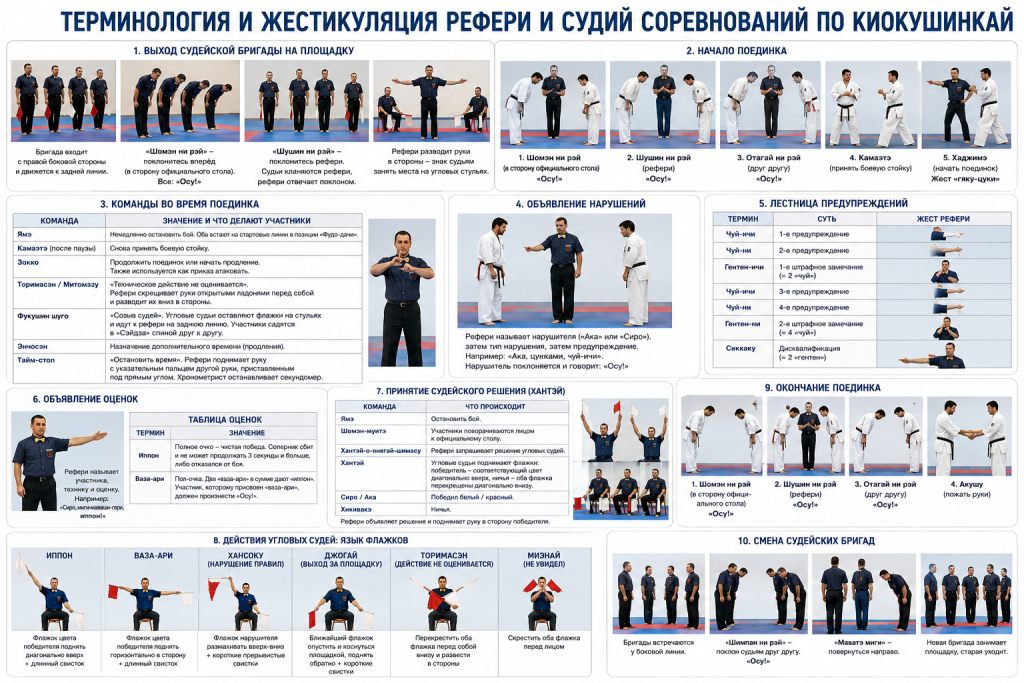
Seiza — kneel down.
Mokuso — close your eyes.
Mokuso yame — open your eyes.
Rei — bow.
Yoi — get ready.
Hajime — begin.
Yame — stop.
Mawatte — turn around.
Hantai — switch (e.g., stance).
Naore — return to the starting position.
Yasume — relax.
Counting
Ichi — one
Ni — two
San — three
Shi — four
Go — five
Roku — six
Shichi — seven
Hachi — eight
Ku — nine
Ju — ten
LEVELS
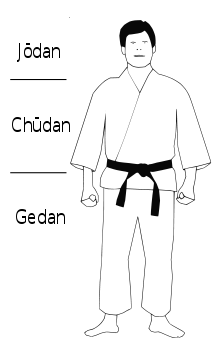
Jodan — upper level
Chudan — middle level
Gedan — lower level
DIRECTIONS
Age — upward
Oroshi — downward
Mae — forward
Yoko — to the side
Ushiro — backward
Mawashi — circular
Soto — outside to inside
Uchi — inside to outside
Hidari — left
Migi — right
Oi — same-side position
Gyaku — opposite-side position
Mae kosa — front cross-step
Ushiro kosa — rear cross-step
Kaiten — spin over the back
Ura — technique performed with a 360-degree rotation
Striking Surfaces of the Body
Hands:
Seiken — fist (front surface: the knuckles of the index and middle fingers).
Uraken — back of the fist.
Tettsui — bottom of the fist.
Shuto — outer edge of the palm.
Haito — inner edge of the palm.
Shotei — heel of the palm.
Koken — wrist.
Nukite — open hand with four extended fingers.
Hiji — elbow.
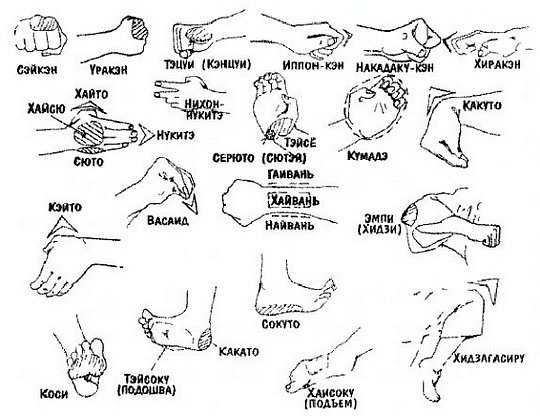
Legs:
Chusoku — ball of the foot
Sokuto — outer edge of the foot
Taisoku — inner arch of the foot
Haisoku — instep
Hiza — knee
Ashi — foot
Kakato — heel
Sune — shin
Stances
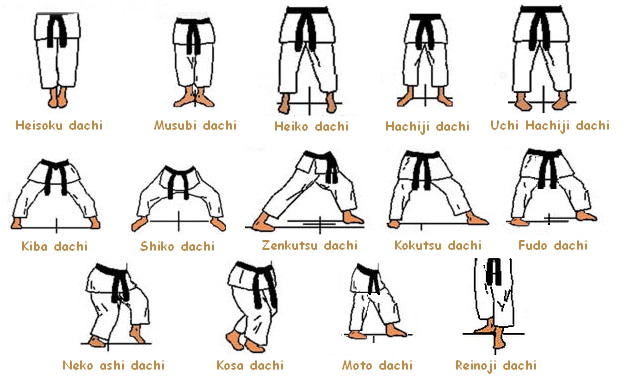
Yoi dachi — ready stance.
Fudo dachi — heels shoulder-width apart, toes turned outward.
Zenkutsu dachi — front leg bent, rear leg straight.
Uchi hachi dachi — heels shoulder-width apart, toes turned inward.
Musubi dachi — heels together, toes apart.
Kokutsu dachi — rear-weighted stance, front heel off the floor.
Nekoashi dachi — similar to kokutsu dachi but with a shorter distance between the feet.
Sanchin dachi — feet shoulder-width apart and slightly bent, one foot one step ahead of the other, both toes turned inward.
Kiba dachi — feet wider than shoulder-width, knees bent at 90 degrees.
Tsuri ashi dachi — single rear-leg stance.
Moro ashi dachi — feet parallel and shoulder-width apart, one foot one foot-length ahead of the other.
Heisoku dachi — feet together.
Kake ashi dachi — crossed stance with one foot stepping behind or in front;
Kamae-te dachi (kumite dachi) — fighting stance.
Blocks
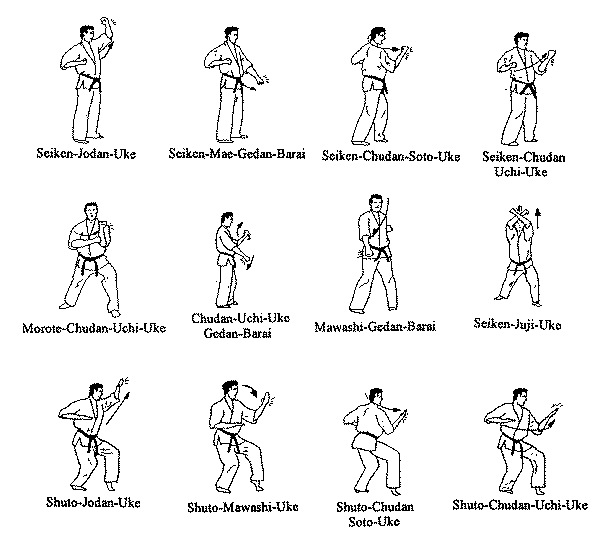
Jodan uke — upper block.
Soto uke — forearm block from outside to inside.
Uchi uke — forearm block from inside to outside.
Gedan barai — downward sweep.
Mae-Mawashi-Uke — front circular block.
Shuto-Mawashi-Uke — circular block in Shuto position.
Morote uchi uke — inside-to-outside forearm block reinforced by the second hand.
Uchi uke gedan barai — double forearm block.
Hand Strikes
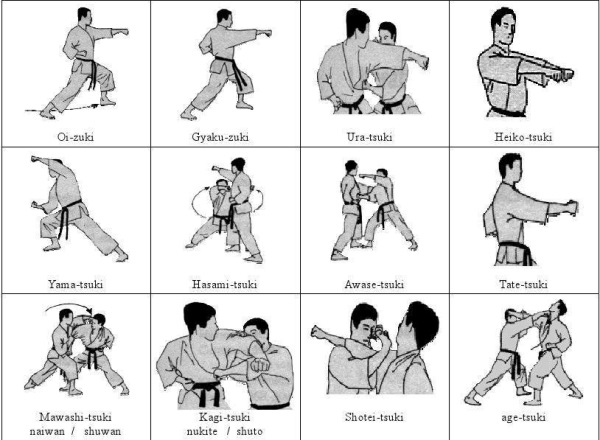
Seiken tsuki — straight punch with the fist
Enkei gyaku tsuki — punch with rotation after a circular block
Tate tsuki — vertical fist punch
Age tsuki — uppercut to the chin
Shita tsuki — hook punch upward to the body
Oroshi tsuki — downward hook punch
Morote tsuki — double punch forward
Yama tsuki — double punch at different levels
Jun tsuki — punch to the side
Shotei uchi — heel-of-palm strike
Yohon nukite — four-finger strike to the throat and solar plexus
Nihon nukite — two-finger strike to the eyes
Hiraken tsuki — strike with the half-clenched knuckles
Hiraken mawashi uchi — circular strike with the half-clenched knuckles to the head
Ryutoken — knuckle strike in «dragon head» position
Toho tsuki — «hook hand» strike to the throat
Ago uchi — snapping strike to the chin
Tettsui oroshi uchi — hammer-fist strike downward
Tettsui kokami uchi — hammer-fist strike to the temple from the side
Tettsui hizo uchi — hammer-fist strike to the ribs from the side
Tettsui yoko uchi — backhand hammer-fist strike to the side
Uraken shomen ganmen uchi — back-fist strike forward
Uraken sayu uchi — back-fist strike to the right and left
Uraken hizo uchi — back-fist strike to the ribs from the side
Uraken mawashi uchi — circular back-fist strike to the head
Shuto sakotsu uchi — knife-hand strike downward to the collarbone
Shuto uchikomi — straight knife-hand strike
Shuto ganmen uchi — knife-hand strike to the side of the head or neck
Shuto hizo uchi — knife-hand strike to the ribs from the side
Shuto yoko uchi — backhand knife-hand strike to the side
Shuto jodan uchi uchi — backhand knife-hand strike forward
Mawashi uchi — circular hook strike
Oyayubi ipponken — circular punch with the thumb-extended one-knuckle fist
Haito uchi — circular strike with the inner edge of the palm
Morote haito uchi — circular strike with both inner edges of the palms
Haishu uchi — backhand strike
Koken uchi — wrist strike
Keiko uchi — fingertip strike to the eye, fingers gathered in a pinch
Mawashi hiji ate — circular elbow strike
Mae hiji ate — forward elbow strike
Age hiji ate — rising elbow strike
Oroshi hiji ate — downward elbow strike
Ushiro hiji ate — rear elbow strike reinforced by the second hand
Kicks
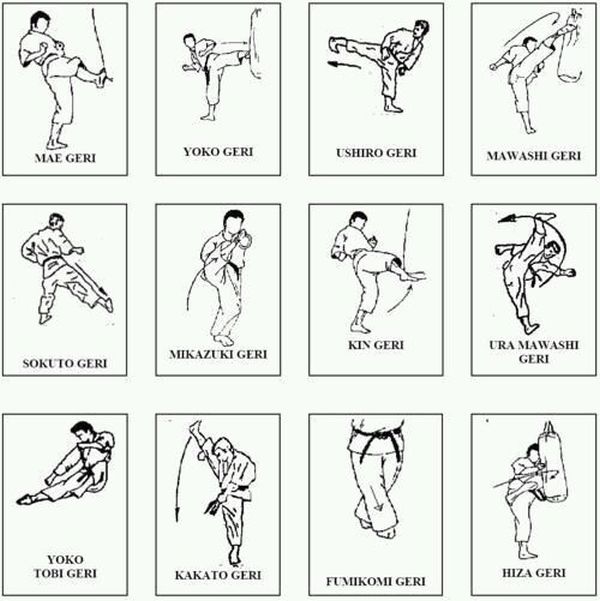
Hiza geri — knee strike
Mawashi hiza geri — circular knee strike
Kin geri — groin kick
Mae geri — front kick
Mae kakato geri — front heel kick
Mae keage — front snap kick
Soto mawashi keage — outward snap kick
Uchi mawashi keage — inward snap kick
Yoko keage — side snap kick
Yoko geri — side kick with the edge of the foot
Kansetsu geri — side kick to the knee joint
Mawashi geri — roundhouse kick
Ushiro geri — back kick
Uchi haisoku geri — diagonal forward kick
Oroshi soto kakato geri — downward strike after an outward circular lift
Oroshi uchi kakato geri — downward strike after an inward circular lift
Kake geri (ura mawashi geri) — reverse roundhouse kick
Ushiro mawashi geri — spinning reverse roundhouse kick (360-degree rotation)
Mae tobi geri — jumping front kick
Nidan tobi geri — double jumping kick at different levels
Yoko tobi geri — jumping side kick
Mawashi tobi geri — jumping roundhouse kick
Ushiro tobi geri — jumping back kick
Ushiro mawashi tobi geri — jumping spinning reverse roundhouse kick
Do mawashi kaiten geri — spinning falling kick
Спасибо большое за отличный сайт, очень информативен! После 14 лет практики Тхэквондо WTF решил занятся Киокушинкай с 0 в возрасте 43 года! Ваш сайт просто находка для новичков!
Спасибо, рады стараться! А вам успехов на пути Киокушинкай)
Спасибо! Много чему научился)
да
спасибо, очень понятный и полезный сайт! занималась каратэ шотокангде делали только ката 4 года и сейчас перешла на кумитэ, захотелось почитать. очень полезно!
Спасибо огромное. очень полезный материал. Картинки не все прогружаются.((
Спасибо, занимаюсь 2 года и не знала вообще ничего, за 3 дня выучила половину, спасибо огромное