
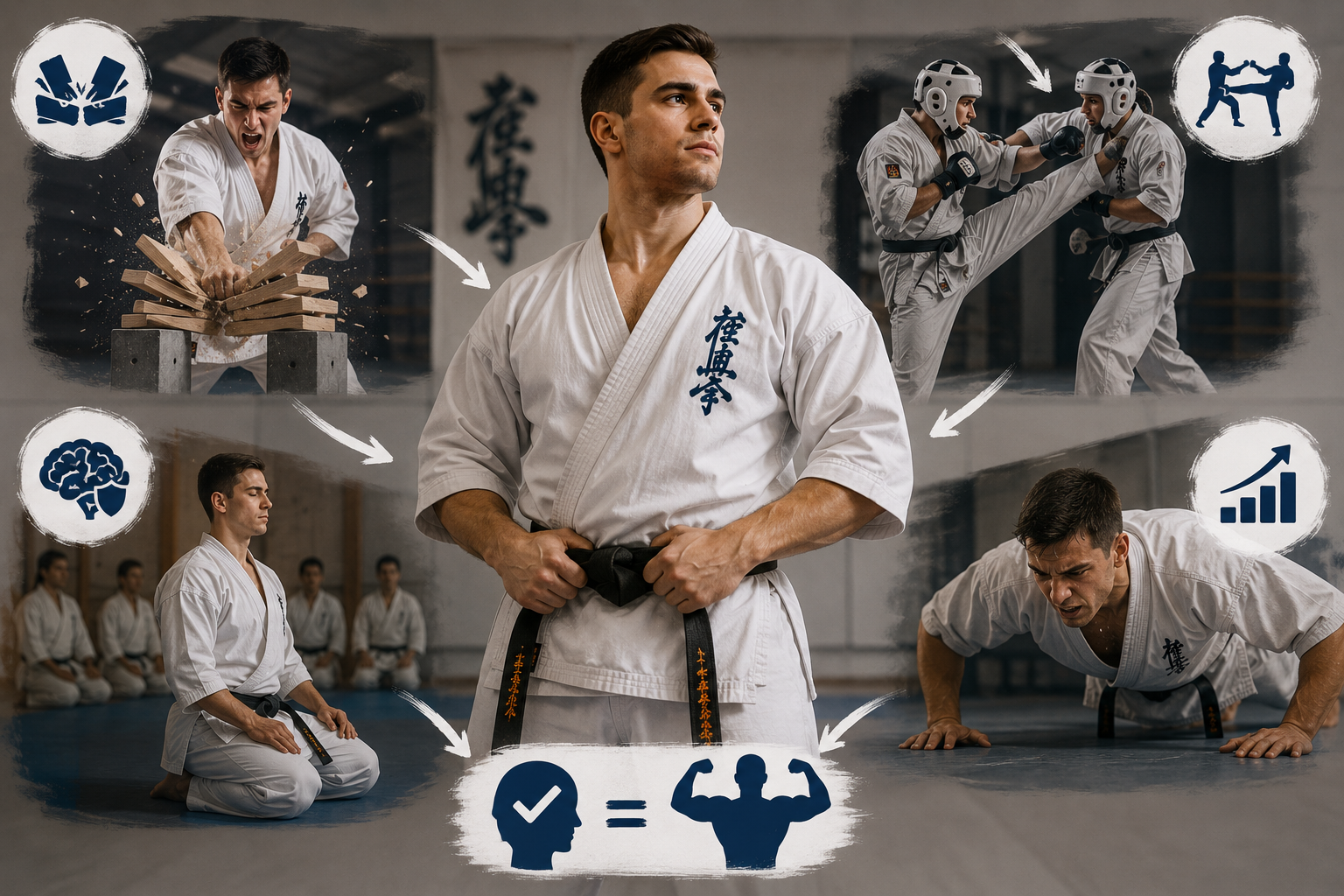
Confidence is often confused with mood: it seems like telling yourself «I can do this» is enough to make fear go away. Sports psychology says the opposite. The most powerful source of confidence is not self-suggestion but the experience of real achievement (in Albert Bandura’s theory this is called mastery experience). Confidence is not what you tell yourself — it is what you have already proven to yourself. Kyokushin is valuable precisely because it produces that kind of proof on a schedule.
Where Confidence Really Comes From
Bandura identified four sources of self-belief. In order of impact:
- Personal mastery experience — doing something you thought was difficult. The most powerful source.
- Seeing others succeed — watching someone at your level pull it off means you can too.
- Words of encouragement — praise from a coach. It works, but is the weakest and fades quickly.
- Physical state — a calm, trained body produces a calm mind.
The takeaway that saves years: motivational quotes and self-talk are the weakest lever. Confidence grows where there is a series of difficulties faced and overcome. Kyokushin is built on exactly that.
How Kyokushin Produces Proof
Each stage of training is a recorded mastery experience:
- Belt gradings — measurable milestones. Today you can do something you could not do six months ago, and it is certified.
- Tameshiwari (board breaking) — concrete evidence of your own strength that cannot be chalked up to luck.
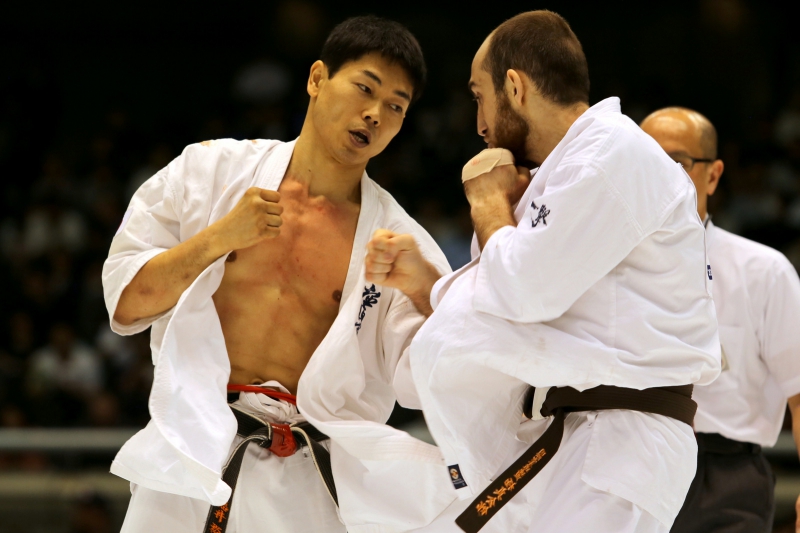
- Kumite — you took the contact and stayed in the fight. Your body remembers that it coped.
- Finishing a grueling training session — the moment your body asked you to stop and you kept going.
From a coach’s perspective, this is the spirit of «Osu» — perseverance under pressure, the willingness to push on when stopping would be easier. The word itself comes from «osu shinobu» — «to endure when pressed.» Every time you continued when you wanted to quit, that goes into a bank from which confidence is later drawn.
Why This Confidence Works Outside the Dojo
Both sides converge here. A stronger, fitter body provides a calm baseline — less anxiety in everyday life (Bandura’s fourth source). And high self-efficacy tends to transfer: a person with experience in overcoming challenges sets bolder goals and does not quit after the first setback. The skill of «this is hard, but I keep going» works equally well in sparring, in negotiations, and in any unfamiliar situation.
Honest Notes on Timelines and Conditions
Confidence does not switch on in a single session — it accumulates. And there is an important caveat: environment matters. If the dojo is one of humiliation and pushing people beyond their limits without support, the effect will be the opposite — anxiety instead of confidence. Look for a dojo where the emphasis is on your personal progress, not on comparison and public shaming. In the right atmosphere, Kyokushin is one of the most reliable ways to stop doubting yourself: it does not talk you into confidence, it gives you proof.

Comments (0)
Leave a comment
Comments are moderated and published after review