Tameshiwari — breaking hard objects — is one of the three competition disciplines in Kyokushin alongside kumite (fighting) and kata (formal sequences). For the spectator it is the most spectacular part of a tournament: athletes break stacks of pine boards with the fist, knife-hand, elbow, and foot. For the athlete, it is a test of focus, striking power, and mental composure.
When and for Whom Tameshiwari Is Held
Tameshiwari is held for male competitors only. Competitions come in two formats: as an additional discipline within a kumite tournament, or as a standalone event.
When tameshiwari is part of a kumite tournament, it takes place before a specific round — generally no earlier than the round of 16 in the open weight category (when 16 athletes are competing simultaneously) or no earlier than the quarter-finals in weight categories (8 athletes). At world championships in the open category, the test begins no earlier than the round of 32, meaning 32 athletes are competing at the same time.
Equipment: Boards and Blocks
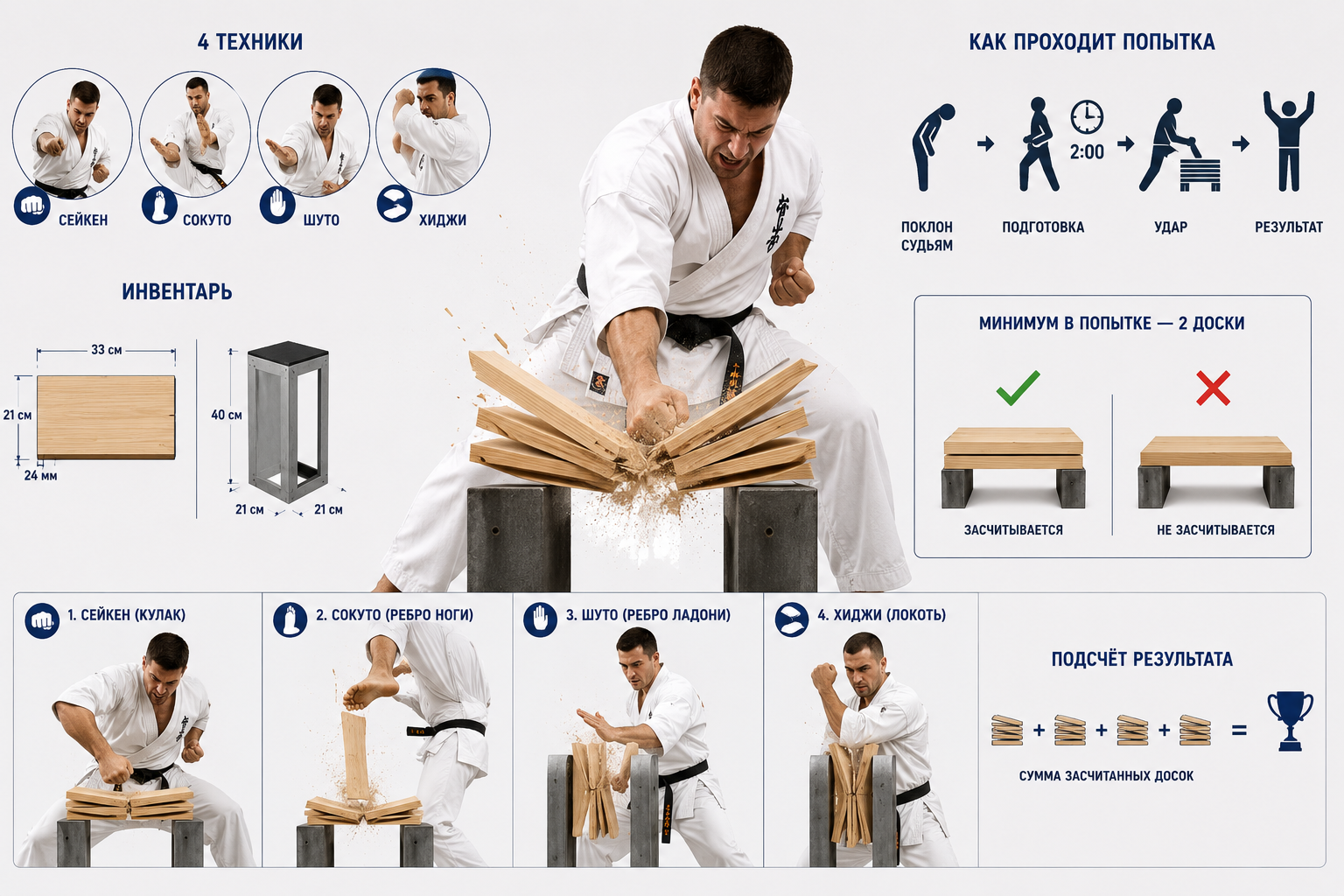
Breaking boards are made from pine or cedar. Dimensions are strictly fixed: 33 cm long, 21 cm wide, 24 mm thick. The surface must be smooth and even so that the boards in the stack fit tightly against each other.
The boards are placed on two support blocks. Blocks may be reinforced concrete, lightweight metal structures, or hardwood with a metal frame. Block dimensions: 40 cm tall, 21 x 21 cm base. Blocks are set on a hard, flat surface.
One important detail: the grain of each board must face downward when stacked — this affects resistance on impact. Boards must not wobble in the stack, and the edges of all boards must be aligned.
An athlete is permitted to place a handkerchief or piece of cloth on top of the upper board to protect the striking surface — but only with the approval of the chief judge, and only after the material has been inspected.
The Four Breaking Techniques
Each athlete performs the break sequentially with four techniques:
- Seiken — the fist (straight punch)
- Sokuto — the foot edge (a dropping knife-foot strike)
- Shuto — the knife-hand
- Hiji — the elbow
For the first two techniques (seiken and sokuto) the blocks are positioned horizontally; for shuto and hiji they are positioned vertically.
If the competition is held at a world championship or if the event regulations specify it, the number of required techniques may be reduced and the minimum number of boards may be increased.
How an Attempt Works
The minimum number of boards in an attempt is two. An athlete may choose to break only the minimum or add any number of additional boards — this is their risk and their strategy.
Each attempt has a time limit of 2 minutes. A warning is given 30 seconds before time expires. If an athlete breaks the boards after time has run out, the attempt is void.
If an athlete fails to break all declared boards on the first attempt, they receive 0 points for that attempt but are given one more chance to break only the required minimum. Failure on the second attempt also results in 0 points for that technique.
Using a different technique or striking surface than the one declared is not permitted: if tettsui (hammer fist) is used instead of shuto (knife-hand), the attempt does not count, even if all boards are broken.
Athletes are not allowed to touch or move the boards and blocks themselves — only the judge may do so at the athlete’s request.
Scoring and Determining the Winner
For each valid attempt, the athlete receives points equal to the number of boards broken. The final result is the total points from all valid attempts across the four techniques.
The winner is the athlete with the highest total. In the event of a tie, victory is awarded to the lighter athlete — provided the weight difference is at least 10 kg in the open weight category and at least 5 kg in weight categories.
If the weight difference is insufficient, a tiebreaker round is held: athletes submit entries to the secretariat stating their chosen technique and board count. Additional attempts continue until one athlete breaks more boards in a valid attempt.
Why Tameshiwari Is More Than a Show
Board breaking may look like a spectacular trick, but it is actually a precise measuring instrument. The number of boards broken is an objective figure that cannot be disputed or interpreted differently. Unlike a bout, where the winner is whoever «performed better» in the judges’ opinion, tameshiwari produces an absolute result. That is precisely why it is used as a tiebreaker in kumite when multiple extensions and weigh-ins end in a draw.
For the athlete, tameshiwari is a test of focus under pressure: you must collect yourself, choose the right moment, strike with maximum precision, and channel all your power into the blow. A nervous or unfocused fighter will not break the boards, no matter how strong they are.
Comments (0)
Leave a comment
Comments are moderated and published after review