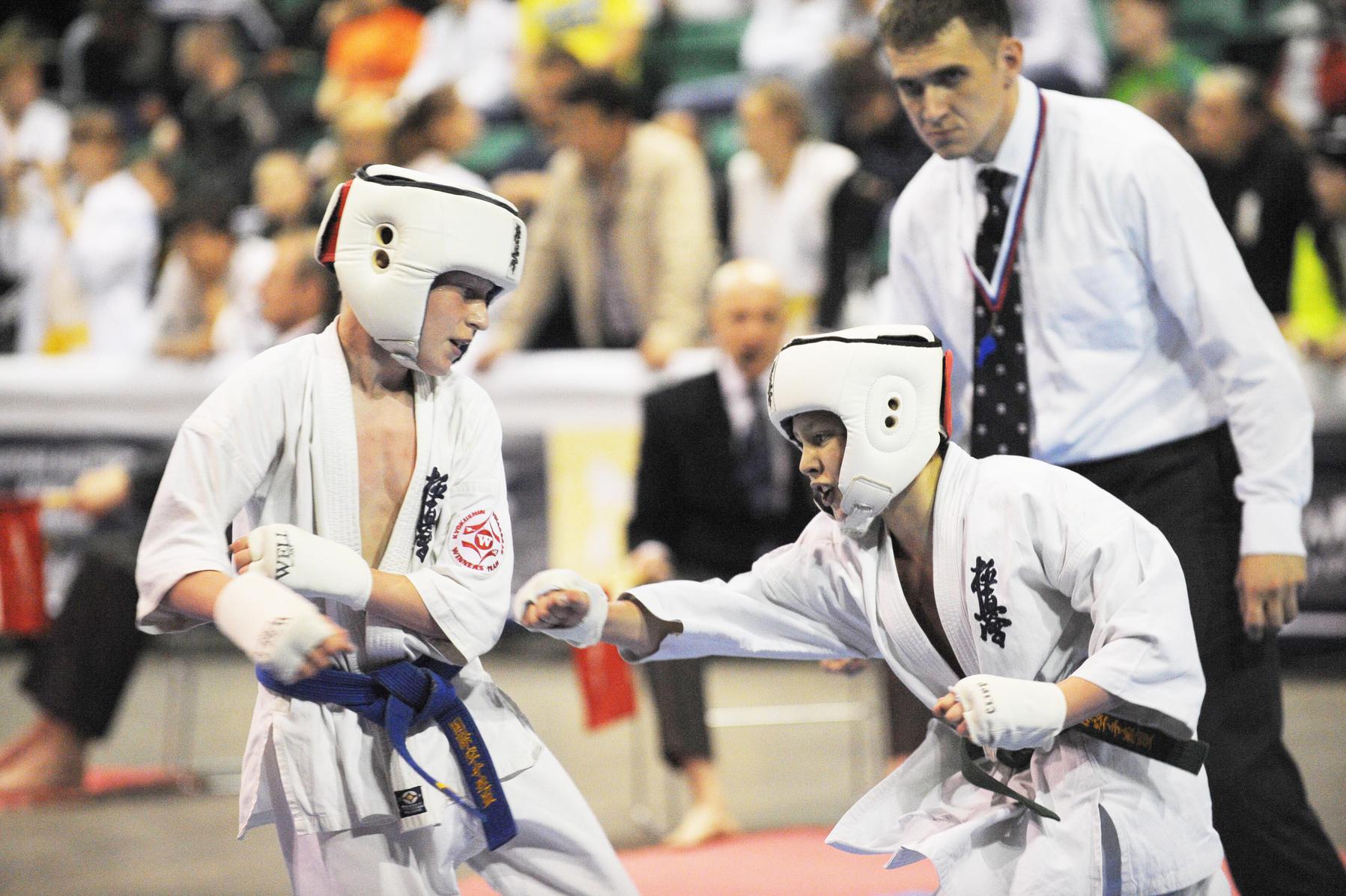
If you’ve come to a Kyokushin tournament for the first time — to cheer on your child or just to watch — what happens on the tatami can seem puzzling: judges call out Japanese commands, wave flags, and stop the bout without any obvious reason. In reality, the judging system is logical and quite straightforward. Here’s a step-by-step breakdown without sports jargon.
Who judges the bout
Five officials work on the floor: the referee (in Japanese, «shushin») stands right on the tatami alongside the fighters, while four corner judges sit at the corners of the area with flags — one white, one red. Each of the five has exactly one vote. Scores and penalties are announced by the referee, but only based on a majority: if three of the five judges see a decisive strike, the score is given; if only two do — it is not.
The flags correspond to the fighters’ belts: before the bout, one competitor is given a white belt («shiro»), the other a red one («aka»). When a corner judge raises a red flag, it means «point to red,» and vice versa.
How a bout starts and ends
Competitors enter the area, bow to the judges’ table, the referee, and each other with the word «Osu!» — the universal greeting in Kyokushin. The bout starts on the command «Kamaete! Hajime!» («Ready! Begin!») and is stopped on the command «Yame!» («Stop!»). After the final decision, the fighters bow again and shake hands — etiquette here is as mandatory as technique.
How long a bout lasts
Bout duration depends on the age of the participants:
| Age group | Main time | Extension |
|---|---|---|
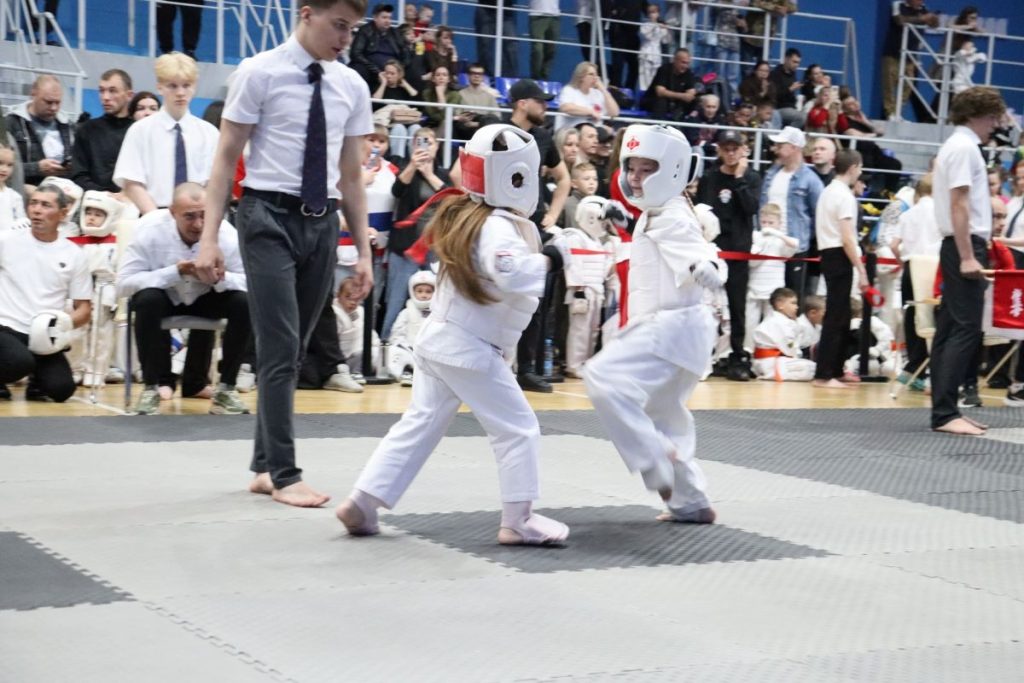
| Children under 8 | 1 minute | 1 minute each |
| Children 8 and older | 2 minutes | 1 minute each |
| Adults (18 and older) | 3 minutes | 2-3 minutes each |
| Veterans (35+) | 2 minutes | 1 minute each |
The end of time is signaled by a gong, and the timekeeper’s assistant throws a red cushion onto the floor — so the signal is visible even in a noisy hall. The bout stops immediately, regardless of the position the fighters are in. A strike landed simultaneously with the «Yame!» command counts; any strike after it does not.
How victory is awarded
In Kyokushin, points are not awarded for every landed hit as in boxing. There are only two types of scores.
«Ippon» (full point) — clean victory. It is awarded if a fighter knocks the opponent down for 3 seconds or more using a legal technique, or if the opponent refuses to continue. The referee counts those 3 seconds silently to themselves — and the bout ends early.
«Waza-ari» (half point) — near victory. The opponent was knocked down or shaken but recovered in under 3 seconds. Two waza-ari together equal an ippon and an early victory. If only one fighter has earned a waza-ari by the end of the bout, that fighter wins automatically.
«Hantei» — judges’ decision. If neither fighter has earned a score, the judges compare the fighters on three criteria: who landed more decisive strikes on target, who showed better technique, and who demonstrated the stronger spirit. A minimum of three votes out of five is needed to win.
What happens in a draw
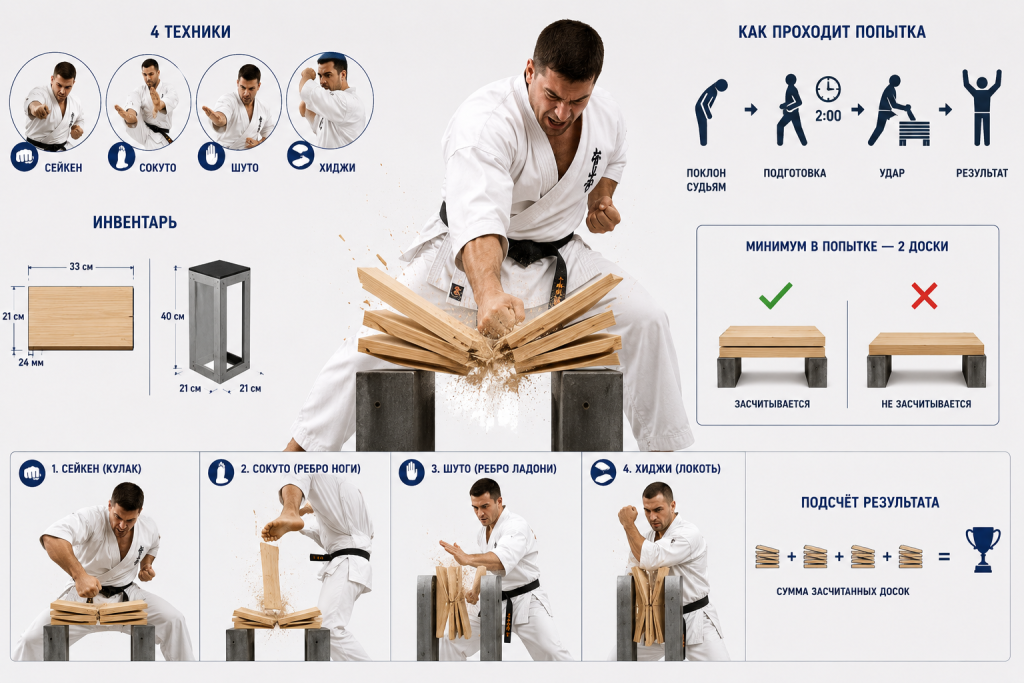
If main time ends and the judges cannot determine a winner, the referee calls an extension — «enchosen.» If that doesn’t resolve it, a second extension is called. After a second drawn extension, the athletes are weighed: if one fighter is lighter than the other by a margin set in the regulations, the lighter fighter wins — the logic being that holding their own against a heavier opponent is itself an achievement. At major tournaments where tameshiwari (board breaking) is held, if weights are equal, those results are compared too. If that still doesn’t decide it, a final, decisive extension is held, after which the judges must name a winner.
What is prohibited
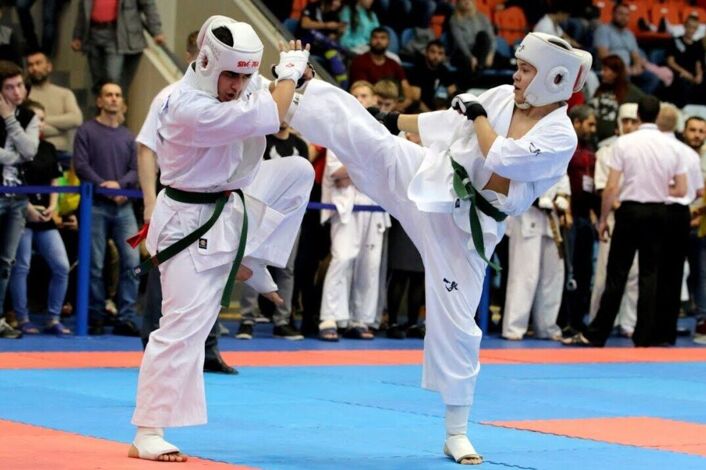
The main thing that surprises newcomers: in Kyokushin fighters compete in full contact, but punching to the head is not allowed. Kicks to the head are permitted; fists are allowed only to the body. Beyond this, the following are prohibited:
- strikes to the groin, neck, or direct kicks to the knee;
- headbutts, scratching, biting;
- grabbing the opponent or their gi, open-palm pushes;
- striking a downed opponent and attacking the back;
- passivity: constant retreating, stepping out of bounds, time-wasting movements, refusing to begin fighting for more than 30 seconds.
In children’s and veterans’ tournaments, the regulations may impose additional contact restrictions — organizers specify these in the competition rules.
Warnings and disqualification
The penalty system has three levels. A violation earns a warning called «chui.» Two «chui» become a penalty point called «genten» — which seriously affects a fighter’s standing in a judges’ decision: all else being equal, the fighter with more penalties loses. Two «genten» mean disqualification, «shikkaku.» Immediate disqualification can be given for a blatant intentional foul, disobeying the referee, or arriving for a bout more than one minute late. There is an encouraging detail: when an extension is declared, all warnings are cleared — fighters start fresh.
If a fighter is injured
When an injury occurs, the referee stops time and calls the doctor. Up to 5 minutes are given for recovery. What happens next depends on the cause: if the injury resulted from a rule violation by the opponent, the injured fighter may be awarded the victory and the violator penalized. If it is an accidental injury with no contact — the judges award no score to either fighter. The doctor can withdraw an athlete from competition at any moment, and that decision is final: the fighter’s health takes priority over the tournament result.
A quick glossary for spectators
- Osu! — greeting and sign of respect;
- Hajime — start the bout, Yame — stop;
- Shiro / Aka — white-belt / red-belt fighter;
- Ippon — clean victory, Waza-ari — half point;
- Hantei — judges’ decision, Hikiwake — draw;
- Enchosen — extra time;
- Chui / Genten / Shikkaku — warning / penalty point / disqualification.
This glossary is enough to follow a bout consciously: you will understand why the referee stopped the fight, who got flags raised and why, and why a bout that seemed even ended with the lighter fighter winning.
Comments (0)
Leave a comment
Comments are moderated and published after review