
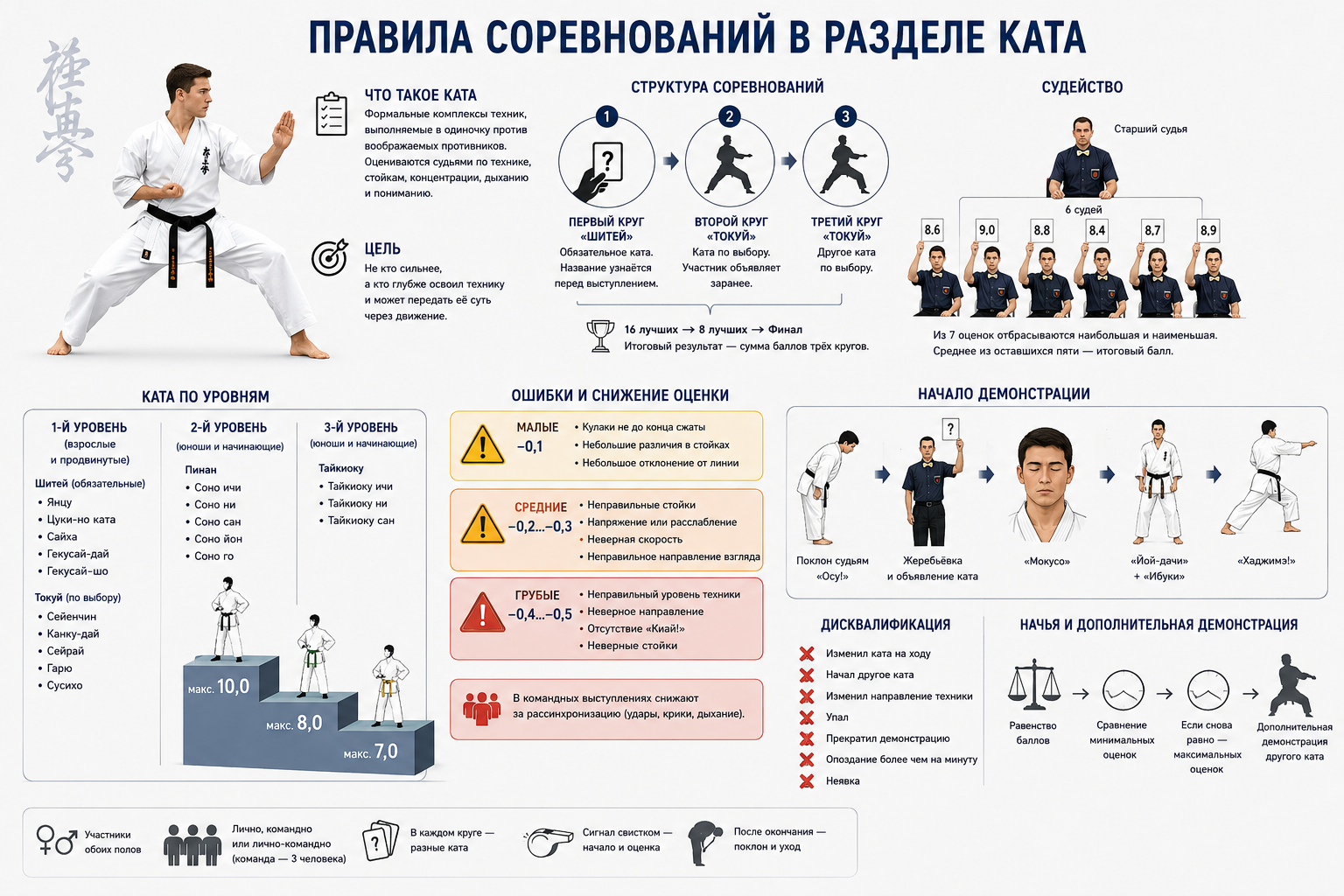
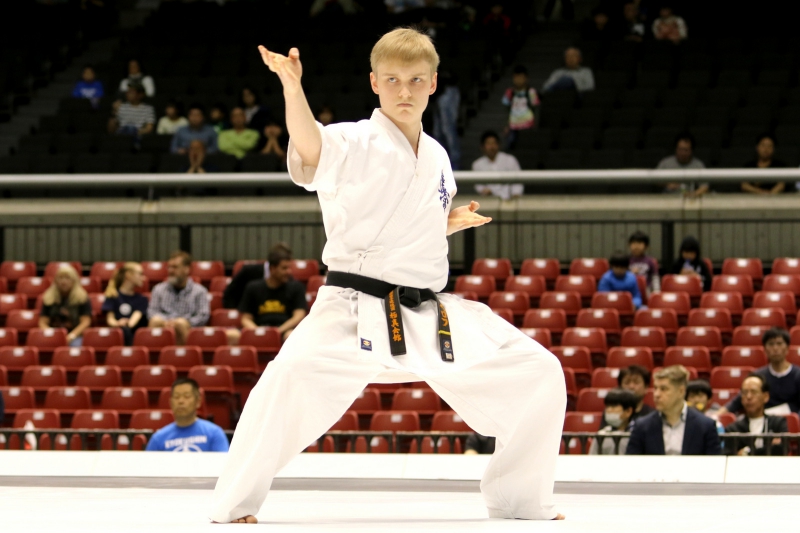
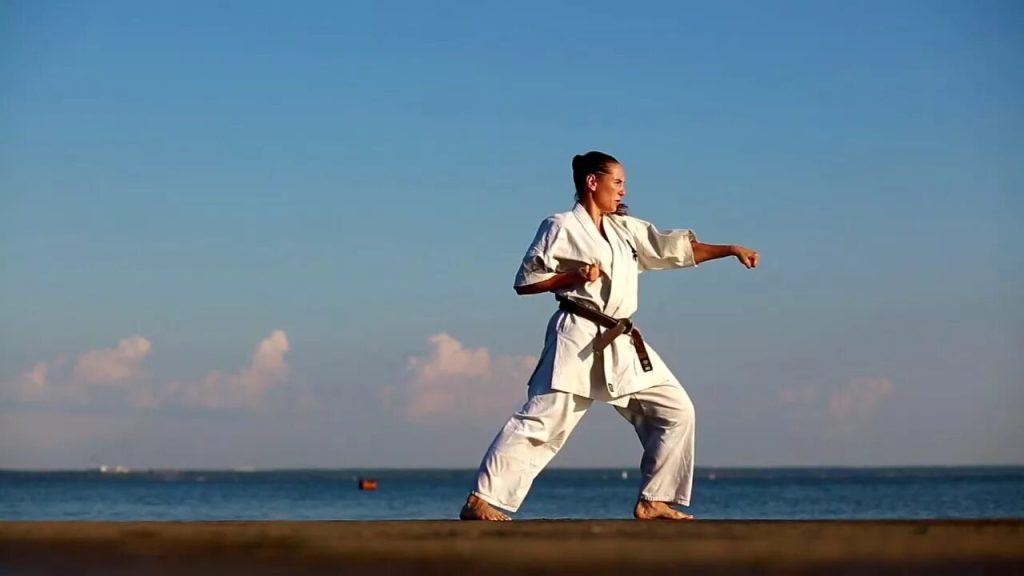
Kata are formal technique sequences: predetermined combinations of stances, blocks, hand and foot strikes, and movements. A fighter performs them solo against imaginary opponents. In competition, kata are judged by referees — on technical precision, stances, concentration, breathing, and understanding of the meaning behind each movement.
Unlike kumite (contact sparring), kata is not about who is stronger. It is about who has mastered the technique more deeply and can convey its essence through movement.
Who Can Participate
Kata competitions are held for participants of both sexes. Events may be individual, team, or individual-team. In team events, three people perform the kata simultaneously.
Competition Structure: Three Rounds
Competitions are held over three rounds.
First round — compulsory kata («shitei»). The judge draws a card with the kata name from a set, and the competitor learns which one they will perform only immediately before going on. This eliminates the possibility of preparing a «signature piece.»
Second and third rounds — kata of choice («tokuyi»). The competitor announces the kata name in advance. The key requirement: a different kata must be shown in each round.
After the first round, the top 16 competitors advance. After the second round, 8 remain — they go through to the final. The final result is the sum of scores from all three rounds.
Judging: How the Score Is Calculated
A panel of a head judge and six judges — seven in total — evaluates the performance. Each judge assigns a score independently, raising their paddle on the whistle signal.
The final score is calculated as follows: from the seven scores, the highest and lowest are discarded; the remaining five are added together and divided by five. The average of these «middle five» is the official result, displayed to two decimal places.
This is standard procedure for a sport with subjective judging: it protects against a single judge deliberately inflating or deflating scores.
Which Kata Are Performed in Competition
Kata are divided into three difficulty levels. At adult and advanced competitions, level 1 applies:
Compulsory kata («shitei») — base score for a correct performance 8.8 points, maximum 9.0:
- Yantsu
- Tsuki-no kata
- Saiha
- Gekusai-dai
- Gekusai-sho
Kata of choice («tokuyi») — base score 9.8 points, maximum 10.0:
- Seiyunchin
- Kanku-dai
- Seipai
- Garyu
- Suishi
At youth and beginner competitions, simpler levels are used. Level 2 includes the five «Pinan» kata (Sono ichi through Sono go), and level 3 includes three «Taikyoku» kata. Maximum scores there are lower — 8.0 and 7.0 points respectively.
Reasons for Score Deductions
A judge starts from the base score and subtracts points for errors. Errors fall into three categories:
Minor errors (-0.1 point) — small flaws: fists not fully clenched, stances of the same type slightly inconsistent in size, performance ending not exactly on the starting line but within one foot’s length.
Medium errors (-0.2-0.3 points) — noticeable: strikes not initiated from correct stances, arm too tense or too relaxed, incorrect speed of technique execution, heel of the supporting foot raised during a kick, gaze direction not matching the technique.
Major errors (-0.4-0.5 points) — clear: strike performed at the wrong level (jodan instead of chudan), incorrect direction of technique, Kiai absent or placed incorrectly, stances too elongated, wide, or high.
In team events, additional points are deducted for lack of synchronization: if team members are out of sync in strikes, kiai, or breathing, that is also an error — minor, medium, or major depending on the degree of discrepancy.
Disqualification
A competitor is disqualified from a performance if they: changed the kata mid-performance, began performing a different kata from the one announced, changed the direction of technique, fell, or stopped before completing the performance. Competitors are withdrawn from the tournament for arriving more than a minute late or failing to appear.
How a Performance Begins
The announcer calls the competitor. They enter the rear zone of the mat, bow to the judges with «Osu!», and step to the starting line. In the first round the head judge draws a card at random and announces the kata name. The competitor repeats it aloud, closes their eyes on the command «Mokuso,» takes the «Yoi-dachi» position with active «Ibuki» breathing, and begins the performance on the command «Hajime!» Afterward — bow, wait for scores, exit the mat.
Ties and Additional Performances
In the event of equal final scores, the advantage goes to the competitor with the higher lowest score in the relevant round. If that is also equal — to the one with the higher top score. If that still doesn’t resolve the tie, an additional performance is held: after the first round — compulsory kata; after the second and third rounds — kata of choice, but one that has not been shown before.
Comments (0)
Leave a comment
Comments are moderated and published after review