
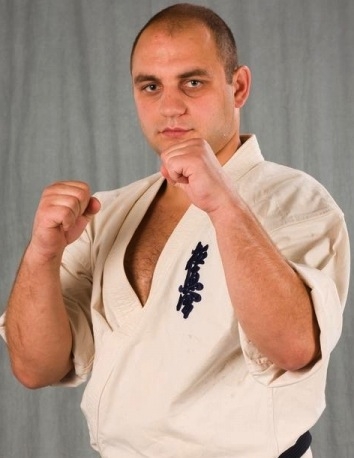
Sergey Plekhanov — one of the strongest Russian fighters in the history of IKO Kyokushinkaikan
Biography
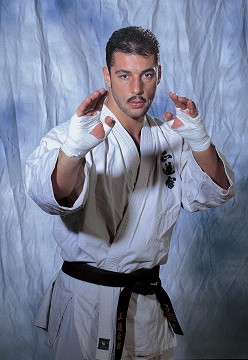
Sergey Plekhanov is one of the most recognized Russian karateka in the history of IKO Kyokushinkaikan. In the early 2000s, he became a symbol of the rapid rise of the Russian Kyokushin school and was one of the first fighters from Russia to reach the final of the IKO Absolute World Championship.
Plekhanov was born in Russia and started training karate at a young age. During his formative years, Russian Kyokushin was just beginning to develop actively, while the Japanese school was still considered the dominant force in world full-contact karate.
From an early age, Sergey stood out for his serious approach to training, high physical conditioning, and a very aggressive fighting style. He was quickly recognized as one of the most promising Russian heavyweights.
In the late 1990s and early 2000s, Russian fighters gradually began competing with the Japanese at the international level. Plekhanov was one of the athletes who proved that the Russian school could challenge for the absolute world championship title.
His name later became one of the most recognizable in Russian Kyokushin.
Achievements
Sergey Plekhanov’s greatest achievement is the silver medal at the 8th IKO Kyokushinkaikan Absolute World Championship in 2003. In the tournament final, he was defeated by Japanese fighter Hitoshi Kiyama and became the world runner-up.
This result was historic for Russian Kyokushin. Plekhanov entered the ranks of the first Russian fighters to reach the final of the IKO Absolute World Championship.
Beyond the World Open, Sergey performed successfully at Russian championships and IKO international tournaments.
Confirmed achievements of Sergey Plekhanov:
- 1997 — silver medalist at the Oyama Cup;
- 1999 — Oyama Cup champion;
- 2000 — Oyama Cup champion;
- 2001 — bronze medalist at the World Championship;
- 2002 — silver medalist at the World Team Championship;
- 2003 — silver medalist at the IKO Absolute World Championship;
- 2003 — World Tameshiwari Champion;
Plekhanov was considered one of the leaders of the Russian heavyweight division and for a long time ranked among the strongest fighters in Europe.
He also participated in international seminars and demonstration events, representing the Russian Kyokushin school.
Greatest Bouts
The defining fight of Sergey Plekhanov’s career is the final of the 8th IKO Absolute World Championship in 2003 against Hitoshi Kiyama.
That bout held great significance for world Kyokushin. It symbolized the moment when the Russian school came within striking distance of the Japanese level in the open category.
Plekhanov put on an extremely hard and competitive fight against the reigning leader of the Japanese school. Despite the defeat, his performance was a tremendous achievement for Russian Kyokushin.
His bouts at international tournaments against the following opponents also drew significant attention:
Japanese heavyweights;
Russian champions;
European IKO fighters;
Brazilian representatives.
Plekhanov was known for almost always imposing a brutal physical battle and rarely conceding in power exchanges.
Fighting Style
Sergey Plekhanov’s style can be described as hard-hitting, pressure-based Kyokushin with an emphasis on physical endurance.
The defining feature of his fights was constant forward pressure and a high volume of attacks. He rarely worked as the second man and preferred to control the pace of the fight himself.
Plekhanov was especially dangerous at mid-range, where he actively used punching combinations and powerful low kicks.
He was also known for his ability to absorb heavy exchanges. Even against strong Japanese fighters, Sergey kept moving forward and pushing the pace.
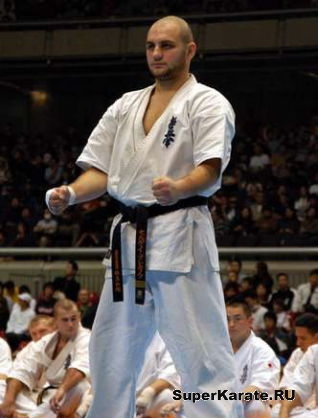
Another important trait was psychological toughness. Plekhanov did not shy away from physical contact and competed confidently even in the most grueling bouts.
His style was a good reflection of the Russian Kyokushin school of the early 2000s: physical power, high tempo, and aggressive pressure.
Signature Techniques
Among the techniques Sergey Plekhanov used most frequently:
gedan mawashi geri;
heavy body punches;
power pressure;
close-range work;
combination attacks.
His low kicks were particularly dangerous. Plekhanov actively used leg kicks to limit the opponent’s mobility and set up further forward pressure.
Body punching also played an important role. In Kyokushin this is a crucial element, and Plekhanov was considered one of the strongest Russian specialists in power work at mid-range.
Russian Championships and International Tournaments
Sergey Plekhanov competed successfully at Russian championships and for a long time was one of the leaders of the national team.
In the early 2000s, the Russian Kyokushin school was developing rapidly and gradually began competing with the Japanese on the world stage.
Plekhanov was one of the fighters who helped raise the international standing of Russian Kyokushin.
Beyond the World Open, he competed at IKO international tournaments and fought against the strongest fighters from Japan and Europe.
Impact on Russian Kyokushin
Sergey Plekhanov played an important role in the development of Russian Kyokushin.
For many young fighters, he became an example that Russian karateka could compete for absolute world championship titles.
His performances at the World Open helped strengthen the reputation of the Russian school on the international stage.
Plekhanov also influenced the popularization of the heavy pressure-based fighting style among Russian athletes.
Interesting Facts
Sergey Plekhanov was the silver medalist at the IKO Absolute World Championship in 2003.
He was one of the first Russian fighters to reach the final of the World Open.
Plekhanov is considered one of the symbols of Russian Kyokushin in the early 2000s.
His style was defined by hard physical pressure and high endurance.
Summary
Sergey Plekhanov is one of the most important figures in Russian Kyokushin. His performance at the World Open in 2003 was a landmark moment in the history of the Russian full-contact karate school.
He entered history as one of the strongest Russian IKO heavyweights — a fighter with a uniquely hard style and an athlete who helped bring Russian Kyokushin to the world stage.
Comments (0)
Leave a comment
Comments are moderated and published after review