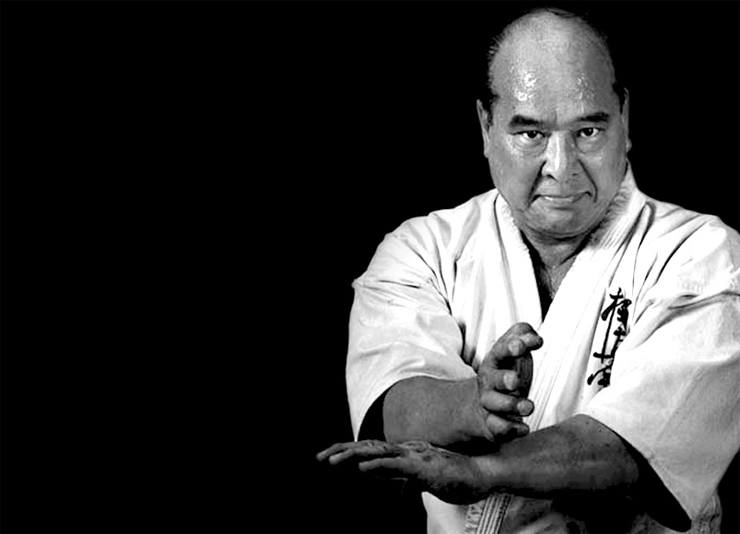
Masutatsu Oyama (1923-1994) was one of the greatest karate masters and the creator of the Kyokushin (Kyokushinkai) style. Oyama held the highest degree — 10th dan (black belt with ten gold stripes); he was a teacher, the author of many books, and the organizer of national and international karate competitions. The international organization IKO (International Karate Organization) he founded has tens of millions of followers worldwide, and he led it until his death. Masutatsu Oyama (1923-1994) was one of the greatest karate masters and the creator of the Kyokushin (Kyokushinkai) style. Oyama held the highest degree — 10th dan (black belt with ten gold stripes); he was a teacher, the author of many books, and the organizer of national and international karate competitions. The international organization IKO (International Karate Organization) he founded has tens of millions of followers worldwide, and he led it until his death.
Biography of Masutatsu Oyama
The future master was born in the Korean city of Gimje into a wealthy family. At that time his homeland was occupied by Japan and was its colony, and Koreans were treated as second-class people. The future master’s real name was Choi Yeong-eui, but like many of his countrymen of that era, he later changed it to a Japanese name and became Masutatsu Oyama.
At the age of two his parents sent Oyama to live on a farm with his older sister, in China. At nine he began studying Chinese kempo, under the instruction of Yi, a laborer from northern Korea. At twelve he returned to Korea, where he continued his education, and a year later earned a black belt in kempo. In 1938 Oyama moved to Japan, intending to train as a military pilot — no small feat for a Korean in pre-war Japan. Despite great hardship, he succeeded and became one of Japan’s first Korean fighter pilots.
In parallel, Oyama studied various martial arts. The next major step in his biography was an encounter with Okinawan karate, which he learned about from university friends who practiced it. This is how Oyama came to know Gichin Funakoshi, an Okinawan karate master and the founder of the Shotokan style, and became his student, taking up the new style.
Oyama’s teachers
Although in his numerous autobiographies Oyama writes in detail about his childhood, there is almost no information about his teachers and mentors — he mentions only in passing that he managed to study various styles such as Shotokan and Goju-ryu, but ultimately chose his own path. Many facts and details in his books do not match or simply contradict one another, which creates the impression that the master deliberately concealed the names of his former teachers.
Nevertheless, some information and recollections about certain mentors have survived. Among those he names is Gichin Funakoshi, of whom he says that he showed him the true essence of karate.
Oyama spoke highly of Daito-ryu aiki-jujutsu master Kotaro Yoshida, under whom he trained in the post-war period. Unfortunately, little is known even about Yoshida himself. Oyama describes his skill as perfect and gives as an example his teacher’s ability to catch a fly mid-flight with chopsticks.
Several years later Oyama began studying Goju-ryu karate, and his teacher became So Nei Chu, a student and associate of the famous Gogen Yamaguchi, who headed the Goju-ryu school at the time. Notably, Nei Chu was also Korean, and from the same province as Oyama himself. It was he who encouraged Oyama to undertake his famous mountain retreat, where Oyama trained alone under grueling conditions. The original plan was to remain for three years; however, Oyama was forced to cut it short after 14 months when he learned that Nei Chu could no longer supply him.
In 1956 an exhibition was held organized by the Tokyomaisekishinbun newspaper, at which there was a demonstration sparring between Oyama and Yamaguchi, by then his teacher. Two years earlier Oyama had been awarded the rank of kyoshi and 7th dan in Goju-ryu, and records of the conferment in Yamaguchi’s own hand survive.
However, in that same year of 1956 Oyama abruptly severed all ties with Yamaguchi and founded his own dojo. The reasons for this break remain unclear to this day. Some researchers believe it was triggered by new techniques Oyama had discovered that did not fit within the Goju-ryu style. According to another version, Oyama realized that thanks to his potential he was capable of surpassing his teacher, and that remaining under him he would always stay second.
Leaving the organization seriously damaged Oyama’s reputation; he had already been fiercely criticized before — for excessive brutality (bouts with him often ended in fractures and injuries), for killing animals (bull fights), and for accepting money during performances in the United States. His action was perceived by conservative karate masters as a betrayal of his teacher, and it definitively branded him a traitor. Only later, when the school Oyama had founded became a major force in the world of karate, were the leaders of other organizations compelled to change their attitude toward Oyama and his style.
Promoter of karate
Undoubtedly, Oyama was one of the chief promoters of karate in the world. In the 1950s he traveled the globe, giving demonstrations and taking on challengers. At the same time he staged his famous bull fights.
Students of Masutatsu Oyama
Oyama trained many talented students, some of whom later founded their own styles. Among them the following are notable:
Shokei Matsui — head of the international organization founded by Masutatsu Oyama — IKO (International Karate Organization)
Midori Kenji — president of the World Karate Organization Shinkyokushinkai (WKO)
Hatsuo Royama — president of the International Kyokusin-kan Federation
Steve Arneil — British master, founder and president of the International Karate Federation IFK.
Daigo Oishi — Vice-president of IKO World SoKyokushin
Jon Bluming — Dutch martial arts master, creator of his own style, founder and president of IBK.
Shigeru Oyama — Japanese master, founder of Oyama karate.
Hideyuki Ashihara — Japanese karate master, founder of Ashihara karate.
Tadashi Nakamura — Japanese karate master, founder of Seido karate.
Dolph Lundgren — American actor, director, screenwriter, and producer; Swedish and British Kyokushin champion.
Interesting facts
Despite his Korean origins, during his years in Japan he became deeply drawn to the samurai traditions of that country. A significant role was played by his passion for novels about the legendary samurai Miyamoto Musashi, whose author Eiji Yoshikawa he later had the opportunity to meet in person. The novel and its author helped Oyama grasp the way of the warrior and also played a part in his decision to undertake voluntary solitary retreat.
During Oyama’s bull fights (by his own account he fought 52 bulls — three were killed and he broke the horns of 48), not everything went smoothly. In 1957, in Mexico City, a bull broke his leg and gored him with a horn. Miraculously Oyama managed to kill the animal and then spent another six months recovering in hospital.
Oyama was originally opposed to women practicing karate. However, he later changed his position after attending kumite bouts with female fighters — an event that prompted him to include photographs of female karateka in his books.
Books by Masutatsu Oyama
Masutatsu Oyama — Mastering Karate
Masutatsu Oyama — This is Karate
Masutatsu Oyama — Classic Karate
Comments (0)
Leave a comment
Comments are moderated and published after review