
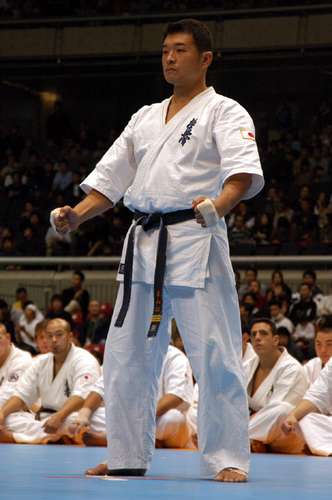
Hitoshi Kiyama — IKO World Champion and one of Kyokushin’s toughest heavyweights
Biography
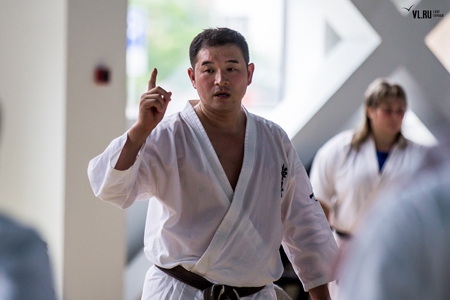
Hitoshi Kiyama is one of the most prominent Japanese Kyokushin fighters of the early 2000s. In the history of IKO Kyokushinkaikan he is remembered as a powerful heavyweight known for his aggressive fighting style, exceptional physical endurance, and the ability to withstand brutal bouts against the world’s strongest competitors.
Kiyama was born on July 18, 1972, in Japan. He came to Kyokushin while still young and fairly quickly distinguished himself from other athletes thanks to his physical gifts and hard fighting manner.
He competed in an era when world Kyokushin had already become a truly international full-contact discipline. At World Opens, dominance was no longer exclusively Japanese — fighters from Brazil, Russia, and Europe were becoming genuine contenders. The competition in the open weight division had grown far more intense than it had been in the 1980s.
It was in this challenging era that Kiyama managed to become World Champion and one of the leading figures of the Japanese IKO school.
He later became known not only as an athlete but also as an instructor and representative of the traditional Japanese approach to full-contact karate.
Achievements
Hitoshi Kiyama’s defining achievement was his victory at the 8th IKO Kyokushinkaikan World Absolute Championship in 2003. In the final he defeated Sergei Plekhanov and was crowned World Absolute Champion. (en.wikipedia.org)
That World Open is considered one of the most competitive tournaments of the early 2000s. With elite fighters from Brazil, Russia, and Europe all competing in the open weight division, Kiyama’s victory carried great significance for the Japanese school.
Beyond the World Championship, Kiyama competed successfully at the All Japan Open and other international IKO tournaments.
He was repeatedly ranked among Japan’s strongest heavyweights and was considered one of the most dangerous fighters of his generation.
Kiyama also participated in international seminars and demonstration events, representing Japanese Kyokushin in various countries.
Notable Bouts
The defining fight of Hitoshi Kiyama’s career is considered to be the final of the 8th World Open in 2003 against Russian fighter Sergei Plekhanov. That bout was a significant clash between the Japanese and Russian schools of Kyokushin.
Kiyama’s victory allowed Japan to retain the IKO World Absolute title during a period when foreign fighters were already posing a serious threat to Japan’s traditional dominance.
His performances at the All Japan Open also attracted significant attention. In Japan, Kiyama regularly faced the country’s top heavyweights and was known for his ability to withstand extremely punishing exchanges.
Among Kiyama’s most notable opponents:
Sergei Plekhanov;
Everton Teixeira;
Hajime Kazumi;
Glaube Feitosa;
other members of the World Open elite from the early 2000s.
Many of Kiyama’s fights were remembered for their high pace and extremely hard contact.
Fighting Style
Hitoshi Kiyama’s style is considered one of the most power-based among Japanese fighters of the early 2000s.
The defining feature of his bouts was constant pressure and a high tempo. Kiyama rarely fought as a counter-fighter and preferred to dictate the terms of the fight himself.
He was extremely dangerous at mid and close range, where he actively worked with combination hand strikes and powerful low kicks.
Kiyama was also noted for his exceptional physical endurance. Even in grueling, drawn-out fights he continued to maintain a high pace.
Another strong suit was his psychological resilience. He absorbed heavy shots calmly and kept moving forward even in the toughest moments of a bout.
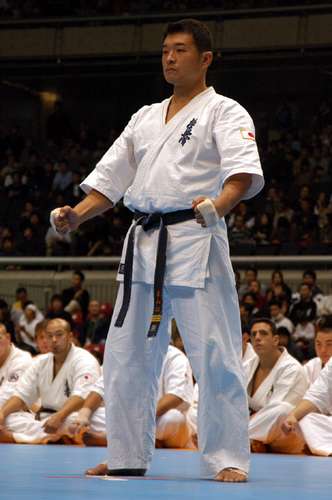
Unlike more technical and mobile fighters, Kiyama built his bouts on physical pressure and the ability to break opponents through sheer intensity.
Favored Techniques
Among the techniques most closely associated with Hitoshi Kiyama:
gedan mawashi geri;
tight hand combinations to the body;
mawashi geri;
power pressure;
close-range work.
Kiyama’s low kicks were exceptionally heavy and served as a tool to restrict his opponent’s movement.
He also worked actively with hand strikes to the body. In Kyokushin, punches to the head are prohibited, so the ability to attack the body effectively is of critical importance.
Kiyama favored constant pressure and rarely allowed opponents to work comfortably at distance.
International Tournament Appearances
Beyond his World Open victory in 2003, Kiyama competed actively in Japanese and international IKO tournaments.
In the early 2000s, competition in the open weight division had reached one of the highest levels in Kyokushin history. Tournaments featured the strongest fighters from Japan, Russia, Brazil, and Europe.
The fact that Kiyama succeeded during this demanding period makes his victory all the more significant.
His name continues to be mentioned among the finest Japanese Kyokushin heavyweights of the early 21st century.
Legacy in Kyokushin
Hitoshi Kiyama is regarded as one of the symbols of the hard, power-based Kyokushin of the early 2000s.
For many young karateka, he became an example of a fighter who wins not only through technique but through character, endurance, and relentless pressure.
His fights are often cited as an example of classic IKO full-contact tournament fighting.
Kiyama also played an important role in preserving the prestige of the Japanese Kyokushin school during a period of rapid growth among foreign fighters.
Interesting Facts
Hitoshi Kiyama became IKO World Absolute Champion in 2003.
In the World Open final he defeated Russian fighter Sergei Plekhanov.
Kiyama is considered one of the toughest Japanese heavyweights of his era.
His style is often cited as an example of classic power-based IKO tournament Kyokushin.
Summary
Hitoshi Kiyama is one of the most significant IKO fighters of the early 2000s. His World Absolute Championship victory cemented his status as one of the strongest heavyweights of his generation.
He entered the history books as a representative of the hard Japanese full-contact school — a World Champion and a fighter capable of enduring the most brutal bouts against the best karateka on the planet.
Comments (0)
Leave a comment
Comments are moderated and published after review