
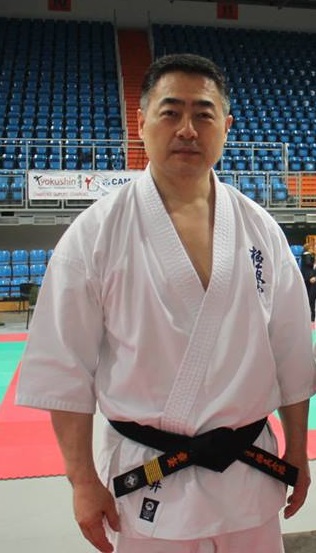
Akiyoshi (Shokei) Matsui – World Champion and head of IKO Kyokushinkaikan
Biography
Akiyoshi Matsui is one of the most influential figures in the history of Kyokushinkai. He is known not only as a world champion in full-contact karate but also as the man who, after Mas Oyama’s death, took the helm of International Karate Organization Kyokushinkaikan and preserved the influence of the classic IKO worldwide.
Matsui was born on January 15, 1963, in Japan. The master’s given name is Yoshimichi Matsui. He began training in karate as a teenager and stood out among other students fairly quickly thanks to a combination of strength, discipline, and an extremely serious approach to training.
He trained during the period when Japanese Kyokushinkai was at the peak of its popularity. Competition inside Japan was enormous: to become one of the best, an athlete had to endure hard training and regularly come through tough tournaments.
In his youth Matsui was regarded as one of IKO’s most promising fighters. Even then coaches noted his ability to handle heavy loads, work confidently in full contact, and sustain a high tempo throughout a bout.
After his competitive career he became not only a karate master but one of the chief leaders of world Kyokushinkai.
Achievements
Akiyoshi Matsui’s main sporting achievement was his victory at the 4th IKO Kyokushinkaikan Absolute World Championship in 1987. At that tournament he defeated the strongest fighters in the world and became absolute champion. (en.wikipedia.org)
This victory was a defining moment in Kyokushinkai history. In the late 1980s competition in the open weight category was extremely fierce, and the World Open was already considered the premier tournament in world full-contact karate.
Beyond the world championship victory, Matsui competed successfully at the All Japan Open. He was among the strongest Japanese fighters of his generation and consistently advanced to the late stages of major tournaments.
Worth noting separately is his completion of the 100-man kumite. In 1986 Matsui passed the famous trial of 100 consecutive bouts, becoming one of the few karatekas in history to endure this test. (kyokushinkaikan.org)
After Mas Oyama’s death, Matsui became the official head of IKO Kyokushinkaikan – making him one of the most influential figures in world Kyokushinkai.
Notable Fights
The most celebrated bout in Matsui’s career is the final of the 4th Absolute World Championship in 1987. That victory made him a world star of Kyokushinkai.
His fights at the Japan Championships also attracted great attention. Matsui regularly faced the strongest Japanese karatekas of his era, including Kenji Midori, Hiroki Kurosawa, and other heavyweights.
One of the most significant rivalries was the final of the 5th World Open in 1991 against Kenji Midori. In that bout Matsui lost, and Midori became the new world champion. This fight is considered one of the symbols of the generational shift in Japanese Kyokushinkai.
Matsui was known for his ability to withstand heavy exchanges. Even against very aggressive opponents he rarely lost composure and continued to impose his own pace.
Fighting Style
Akiyoshi Matsui’s style can be described as classic power Kyokushinkai. He built his fights on constant pressure, hard contact, and physical endurance.
Matsui was not the fastest fighter of his time, but he had an excellent sense of distance and the ability to gradually break down an opponent through a heavy pace.
One of the main features of his style was body work. He actively used hand combinations and kept his opponent working under constant pressure.
Matsui was also renowned for his incredible durability. In tough fights he rarely showed fatigue and kept pushing forward even after taking serious hits.
His style had almost no wasted motion. He worked simply, hard, and very effectively.
Favorite Techniques
The techniques most often associated with Akiyoshi Matsui:
tight body combinations with the hands;
gedan mawashi geri;
mawashi geri to the mid-level;
close-range power pressure.
Matsui actively used low kicks to break down his opponent’s stance. His low kicks were not always spectacular but worked very well over long-distance fights.
An important part of his style was also constant hand combinations. Body work carries enormous weight in Kyokushinkai, and Matsui was considered one of the best specialists in that component.
He preferred a reliable, pragmatic style, relying not on spectacular knockouts but on systematic pressure.
International Tournament Record
Matsui competed during the era when Japanese fighters still dominated the World Open. His 1987 victory reinforced the position of the Japanese school of Kyokushinkai on the world stage.
Beyond the absolute world championships, he was active in Japanese tournaments and IKO international competitions.
Later, as head of IKO, Matsui continued developing international tournaments and the world championship system.
Under his leadership the organization maintained its status as one of the largest structures in world Kyokushinkai.
Influence on Kyokushinkai
After Mas Oyama’s death, Akiyoshi Matsui became the official head of IKO Kyokushinkaikan – making him the central figure of world Kyokushinkai in the late 1990s and 2000s.
Under Matsui’s leadership the organization continued to host the World Open, All Japan Open, and international tournaments.
He actively developed IKO’s international network of representatives and promoted Kyokushinkai in Europe, Russia, South America, and other regions.
For many athletes Matsui became a symbol of continuity with the classic Kyokushinkai of Mas Oyama.
Interesting Facts
Akiyoshi Matsui became IKO Absolute World Champion in 1987.
He completed the 100-man kumite – one of the most grueling tests in Kyokushinkai history.
After Mas Oyama’s death, Matsui led IKO Kyokushinkaikan.
Under his leadership IKO maintained its status as one of the largest full-contact karate organizations in the world.
Conclusion
Akiyoshi Matsui is not just a world champion – he is one of the central figures of modern Kyokushinkai. His career combines sporting achievements, the philosophy of full contact, and leadership of the world’s premier karate organization.
He entered history as the strongest fighter of his era, a student of Mas Oyama, and the man who continued the development of classic IKO Kyokushinkaikan after the founder’s death.
Comments (0)
Leave a comment
Comments are moderated and published after review