
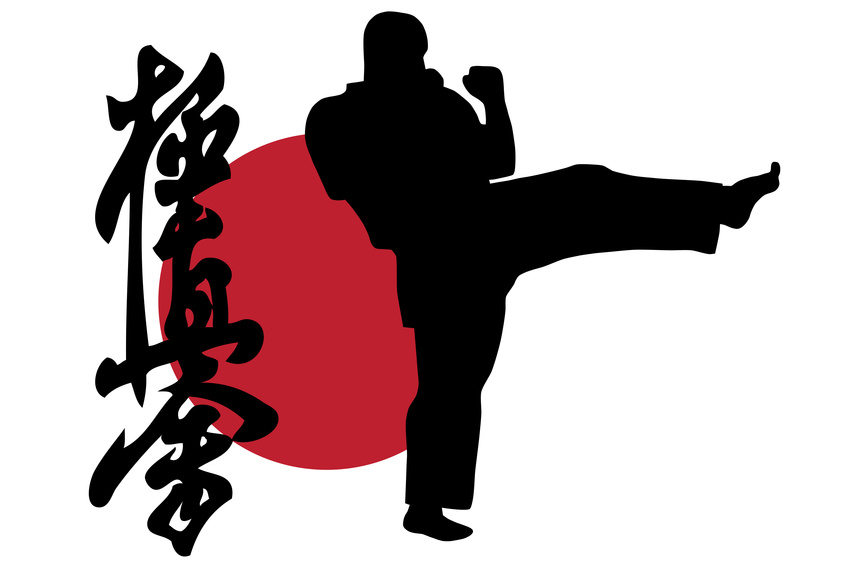
The foundation of Kyokushin style was built on Shotokan and Goju-ryu karate. Mas Oyama, the founder of Kyokushin karate, studied both of these styles in his youth and later decided to create his own, one that would differ from conventional styles while drawing on their best elements. Kyokushin inherited its foundations from Shotokan and adopted more advanced techniques and striking methods from Goju-ryu.
The foundation of Kyokushin style was built on Shotokan and Goju-ryu karate. Mas Oyama, the founder of Kyokushin karate, studied both of these styles in his youth and later decided to create his own, one that would differ from conventional styles while drawing on their best elements. Kyokushin inherited its foundations from Shotokan and adopted more advanced techniques and striking methods from Goju-ryu.
Short answer
Kyokushin differs from many karate styles through its emphasis on conditioning, full-contact kumite under its own rules, and systematic practice of kata and kihon. Specific competition rules and training syllabi depend on the organisation and school.
Key points
- Kyokushin combines kihon, kata, conditioning, and kumite.
- Its competition rules differ from those of other karate styles and can vary between organisations.
- Choose a club based on its coach, training conditions, and your own goals.
Kyokushin Technique
The core technique of Kyokushin consists of straight and circular punches and kicks. The primary emphasis is on powerful close-range fighting, which is why Kyokushin places less focus on long-range kicks compared to Shotokan. At close range, elbow and knee strikes to the body and thighs are also used in addition to standard punches. Since reacting to a fast hand strike is harder than reacting to the slower kick, punches to the head are prohibited in Kyokushin.
Sparring in Kyokushin Karate
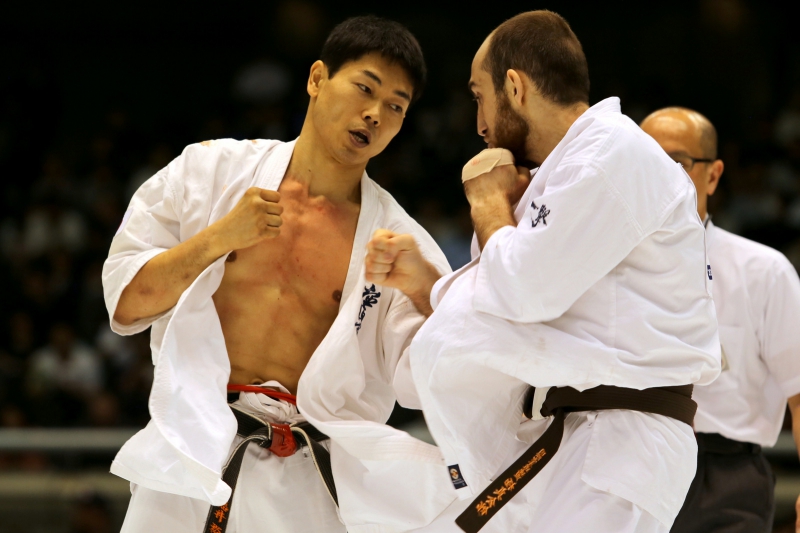
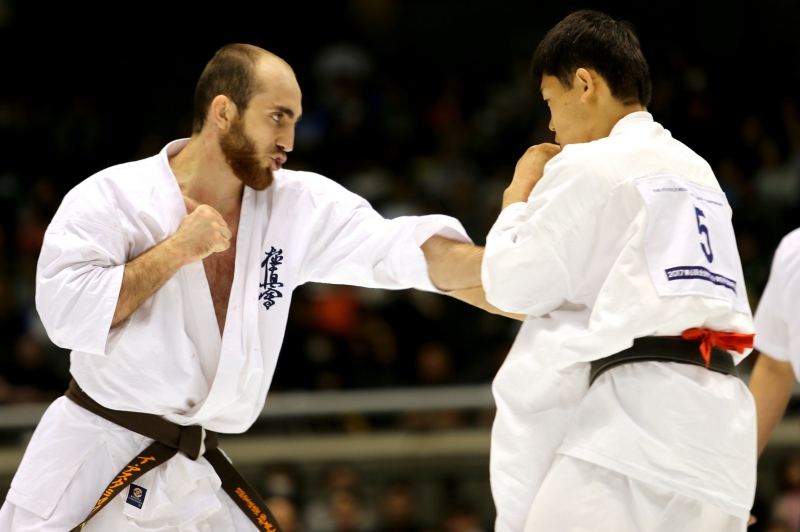
Kumite (sparring) plays a central role in Kyokushin. The competition rules prohibit punches or elbow strikes to the head and neck, kicks to the knee and spine, throws, and wrestling techniques. However, these dangerous techniques are still taught in training for self-defense applications.
Competition
Unlike sparring in many karate styles where only light contact is used without direct striking, Kyokushin sparring is more intense and conducted with full contact. Unlike many other karate styles that use point-based scoring, Kyokushin uses knockdown and knockout rules — referred to as «waza-ari» and «ippon» respectively — which fighters earn by successfully applying various techniques.
Ranks in Kyokushin Karate
As in many Eastern martial arts, Kyokushin divides ranks into student grades (kyu) and master grades (dan), ten levels each. Fighters of different grades are distinguished by belt color, following the principle of «light to dark.» A beginner wears a white belt; upon earning 10th kyu they change to an orange belt. A 9th kyu holder wears an orange belt with a black stripe. As the grade increases, colors shift to blue, yellow, green, brown (odd grades with a stripe), and black. Holders of 1st dan and above wear black belts with gold stripes indicating the number of dan.
Grading for colored belts includes a check of technical knowledge appropriate to the belt level, kata, physical fitness standards, and sparring. Requirements for dan grades (black belts) are stricter and more demanding than kyu tests. For black belt holders, requirements vary by dan level and may include, for example, completing anywhere from 10 to 100 consecutive sparring rounds.
Comments (0)
Leave a comment
Comments are moderated and published after review