
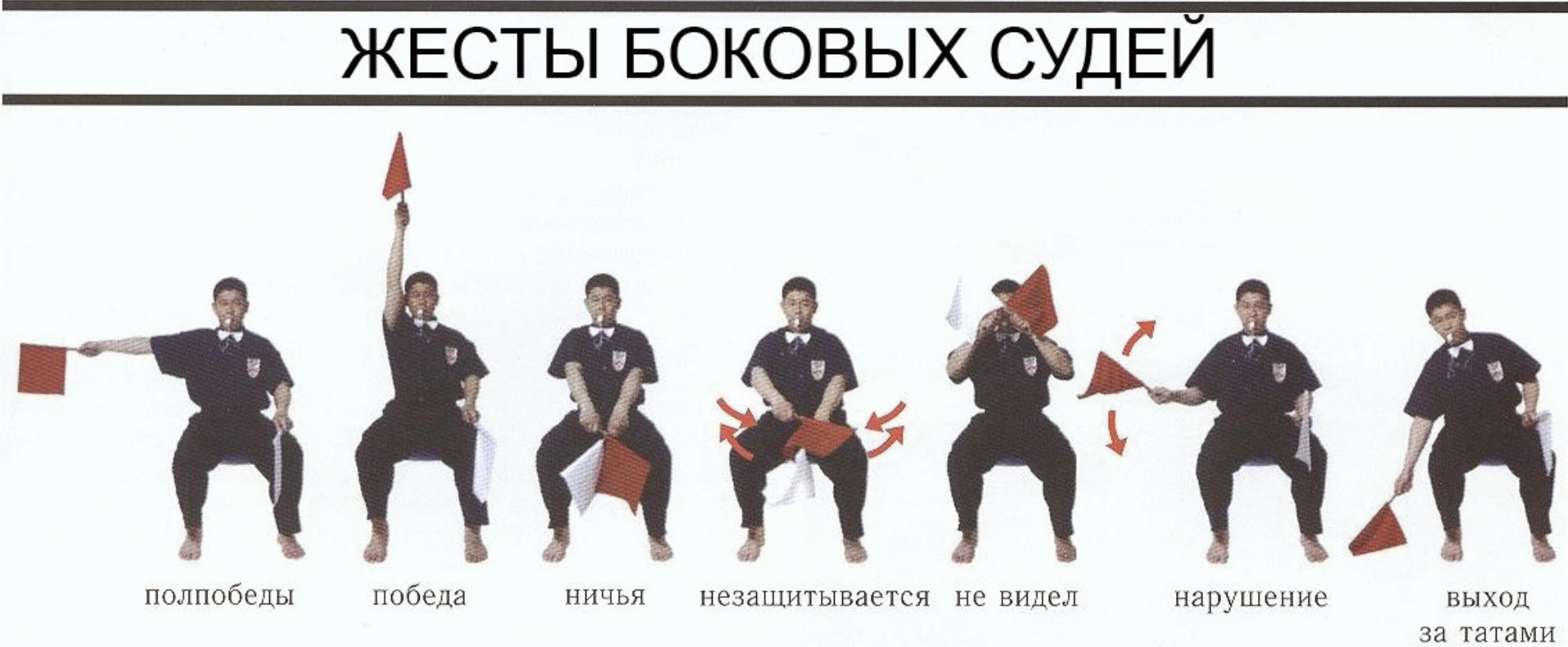
In Kyokushin karate competitions, each bout is officiated by a head referee (shushin) and four corner judges (fukushin). The corner judges sit at the corners of the tatami and signal their decisions using red and white flags. Knowing how to read their gestures is an essential skill for athletes, coaches, and spectators alike.
The Flag System
Each corner judge holds two flags: red (aka) and white (shiro). The red flag corresponds to the fighter wearing a red belt or red marker; the white flag corresponds to the fighter in white. The combined signals of all four corner judges and the head referee determine the final decision for the bout.
Corner Judge Gestures: Full Breakdown
1. Half-point (waza-ari)
The judge raises one flag (in the color of the winning fighter) vertically upward at shoulder height. Two waza-ari count as ippon – a full victory.
2. Full point (ippon)
Both flags are crossed above the head in an X shape, or one flag is raised high above the head. Ippon is a clean victory that immediately ends the bout. It is awarded for a knockdown, an effective combination, or clear technical superiority.
3. Draw (hikiwake)
The judge crosses both flags in front of the chest at chest height in a horizontal X. This gesture indicates that the corner judge cannot determine a winner for that exchange or the bout.
4. No defense (mubomi)
The judge points a flag (or hand) toward the head, mimicking a downward strike. This signal means that a fighter is not defending properly – leaving the head exposed or failing to react to strikes. The head referee may issue a warning (genten) for mubomi.
5. Did not see (mite inai)
The judge covers the eyes with both hands or hides the face behind the flags. This gesture means the judge did not see the moment in question and cannot make a ruling. In this case, the judge’s vote is not counted when determining the outcome of that episode.
6. Rule violation (hansoku)
The judge raises one flag and points it at the offending fighter. Violations include strikes to prohibited areas (punches to the head, groin, or joints), grabs, and pushing a fighter off the tatami. A violation results in a warning or disqualification.
7. Out of bounds (jogai)
The judge lowers a flag and points toward the boundary line of the tatami. Stepping out of bounds pauses the fight. Repeated exits from the tatami (or deliberately avoiding combat by stepping out) are penalized with a genten warning.
How the Decision Is Made
When time expires, the head referee stops the bout with the command “yame” and asks the corner judges to show their decisions. All four flags are raised simultaneously. The head referee announces the winner based on a majority vote (three out of five judges, including the head referee). If the corner judges are split two to two, the head referee casts the deciding vote.
Why Knowing the Gestures Matters
Understanding the flag language helps the athlete in real time during a bout: by watching the judges’ signals, a fighter can gauge how their performance is being evaluated. The corner coach also watches the fukushin’s gestures and can adjust tactics between rounds. For spectators and parents of young athletes, knowing these signals transforms watching a tournament from passive observation into a fully engaged and much more rewarding experience.
Comments (0)
Leave a comment
Comments are moderated and published after review