
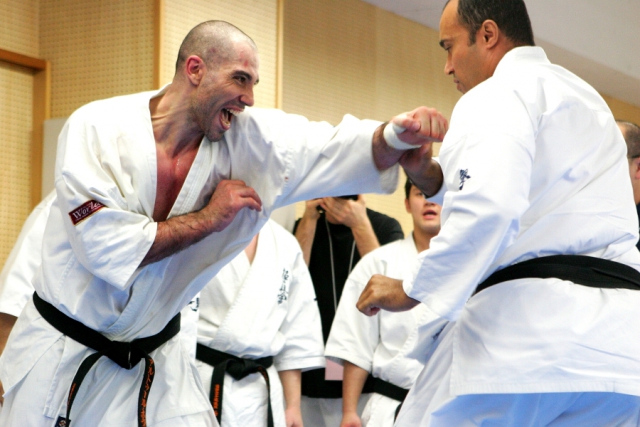
Hyakunin kumite (Japanese: 100-man kumite) is a legendary challenge in Kyokushin karate, regarded as the absolute limit of human endurance. A fighter must complete 100 full-contact bouts in succession against a constantly rotating stream of fresh opponents. Each bout lasts 1.5-2 minutes. By the final rounds, the competitor is fighting in a state of total physical exhaustion – on willpower alone.
Completing the hyakunin kumite is not the athlete’s choice to make. The right to attempt it is granted exclusively by the organization’s leadership. The standard requirement is a victory or podium finish at the World Open, or a win at the All Japan Open (absolute category). Across the entire history of the style – from 1965 to 2021 – only 17 fighters have successfully completed all 100 bouts.
Those Who Completed the Hyakunin Kumite: Full List
During the Lifetime of Masutatsu Oyama (1965-1991)
From May 21, 1965 to May 19, 1991, 16 official tests were conducted. 11 ended in success, 5 in failure.
- Steve Arneil (United Kingdom) – May 21, 1965. The first person in history to officially complete the hyakunin kumite. Scottish by origin, Arneil was one of the first Western karateka to reach the top of Kyokushin. The test was given to him as a trial of spirit before his return home – without any championship requirements.
- Tadashi Nakamura (Japan) – October 15, 1965.
- Shigeru Oyama (Japan) – September 17, 1966. The younger brother of the style’s founder, Masutatsu Oyama.
- Loek Hollander (Netherlands) – August 5, 1967. (result is disputed – see below)
- John Jarvis (New Zealand) – November 10, 1967. About 30 opponents came out against him, each fighting three or more times. In total, instead of exactly 100 bouts, he completed approximately 115. Upon finishing he was promoted to 3rd dan. After the official part came an unofficial one – a walk through Tokyo’s Ueno Park, where street fighters trained.
- Howard Collins (United Kingdom) – December 1, 1972. After IKO reforms under Shokei Matsui, Collins is where the organization’s official list begins.
- Miyuki Miura (Japan) – April 13, 1973. At 22 years of age, he deliberately chose Friday the 13th to prove that for a true karateka, superstitions do not exist. 20 opponents each fought 5 rounds against him. Three hours later, Miura finished with no broken bones or dislocations – though the opponents themselves sustained torn cartilage and sprained ankles. For two days after the test, he was unable to move. American magazine Black Belt Magazine devoted a major feature to him in September 1974.
- Shokei Matsui (Japan) – May 18, 1986. He later became IKO absolute world champion (1987) and led the organization. Under his leadership, the eligibility requirements for the test were significantly tightened.
- Ademir da Costa (Brazil) – April 25, 1987.
- Keiji Sanpei (Japan) – February 25, 1990. (2nd attempt – the only person to attempt it twice). His first attempt in 1979 was stopped by Oyama himself at bout 49. Eleven years later, at age 35, Sanpei was sitting his 5th dan examination. Having completed the required 50 bouts and feeling no fatigue, he himself asked permission to continue to 100. Oyama agreed – the test was officially recognized.
- Akira Masuda (Japan) – May 19, 1991. The last person to complete the hyakunin kumite during the founder’s lifetime. Masutatsu Oyama died in April 1994.
After Oyama’s Death (1995-2014, IKO Matsui)
- Kenji Yamaki (Japan) – March 25, 1995. He completed the test immediately before the 6th World Open – and went on to win that championship, defeating Hajime Kazumi in the final. By his own account, the hyakunin kumite helped him test his striking power and build confidence ahead of the tournament.
- Francisco Filho (Brazil) – March 18, 1998.
- Hajime Kazumi (Japan) – March 13, 1999.
- Artur Hovannisyan (Armenia) – March 29, 2009. The first representative of the post-Soviet space to complete the test. In interviews he admitted: 100 kumite cannot be managed functionally – it is beyond the realm of possibility.
- Tarik El Mlouki (Morocco) – April 24, 2010. The first African in history to complete the hyakunin kumite.
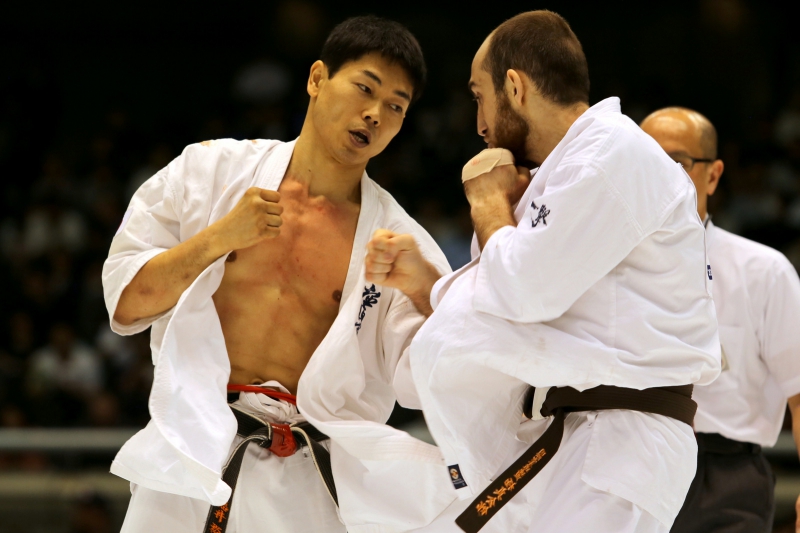
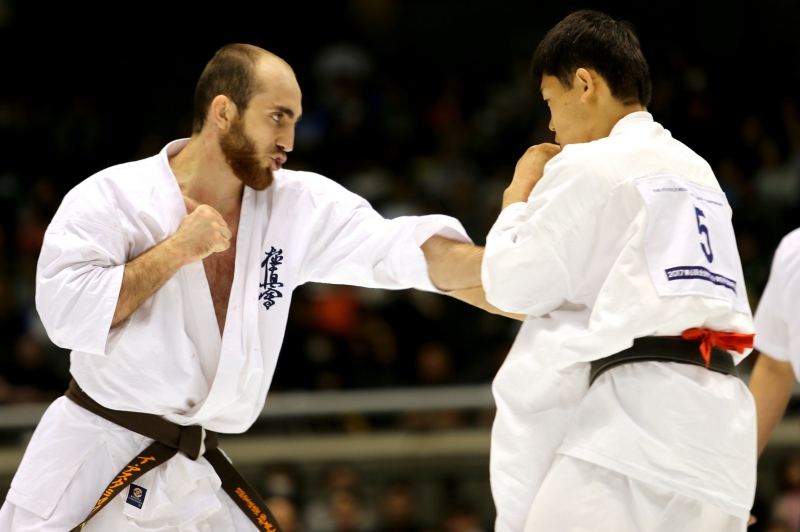
- Tariel Nikoleishvili (Georgia) – April 26, 2014, Tokyo, IKO Honbu. The only reigning absolute world champion to face the test while holding the number-one ranking. The test lasted 3 hours and 21 minutes. At bout 93, a cramp seized his right hand – and he completed the remaining bouts effectively with his left alone. The final, 100th bout – against Kyohei Azima (2nd dan, 90 kg) – ended in a draw. Final record: 21 ippons, 30 waza-ari, 13 wins by judges’ decision, 27 draws, 9 losses. At bout 89, chief referee Matsui threatened to stop the test, demanding that opponents attack more aggressively. Tariel’s main weapon was ashi-barai – in the final quarter of the test alone he scored 8 points with it.
Failed Attempts
| Fighter | Date | Stopped At | Circumstances |
|---|---|---|---|
| Yasuhiko Oyama (Japan) | September 1972 | Bout 61 | – |
| Keiji Sanpei, 1st attempt | August 24, 1979 | Bout 49 | Stopped personally by Oyama |
| Makoto Nakamura (Japan) | August 26, 1979 | Bout 35 | – |
| Kazuo Miyoshi (Japan) | August 26, 1979 | Bout 45 | – |
| Kazuhiko Ogasawara (Japan) | November 18, 1984 | Bout 43 | – |
| Zakhari Damyanov (Bulgaria) | April 20, 2016 | Did not finish | Reigning world champion 2015 |
| Mikio Ueda (Japan) | April 25, 2021 | Bout 60 | Leg injury, age 25 |
Zakhari Damyanov won the world championship title in November 2015 and faced the hyakunin kumite on April 20, 2016. His coach, Shihan Emil Kostov, announced to journalists that Zakhari would become the tenth fighter to complete the test. It did not happen.
Mikio Ueda stopped at bout 60 due to a leg injury. The test fell in April 2021 – a pandemic year, having been postponed by 12 months. At the point of stopping, his record stood at: 2 ippons, 12 waza-ari awasete ippon, 9 waza-ari, 10 wins by decision, 17 draws, 10 losses. He was 25 years old – an age that leaves hope for a second attempt.
Disputed and Unofficial Attempts
Peter Chong (Singapore), August 1968. He completed 30 bouts on a sandy beach during a summer camp near Chiba. On returning to Tokyo, police stopped him due to his numerous visible injuries. The story was covered in Black Belt Magazine (January and July 1969), but journalist Wilfred Schimmen questioned its authenticity. Not officially recognized.
Loek Hollander (Netherlands), August 5, 1967. Masutatsu Oyama personally presented him with a commemorative plaque and officially added him to the records. However, witnesses Harry Seriese and Jon Bluming independently stated that Hollander stopped after 28-29 bouts. Under Shokei Matsui, his result ceased to be officially recognized. Most likely the test was not completed in full, but recognition was granted for the sake of promoting Kyokushin in Europe.
Myths and Interesting Facts
The myth of Oyama’s 300 bouts. A number of popular sources claim that Masutatsu Oyama himself completed 300 bouts over three days. This does not match the historical record. Oyama created the hyakunin kumite as a test for his students – he himself never participated in any official format.
The unique record of the 1995 top three. All three medalists at the 6th World Open – Kenji Yamaki (1st), Hajime Kazumi (2nd), and Francisco Filho (3rd) – subsequently completed the hyakunin kumite. Such a coincidence has never occurred before or since.
Great champions who never faced the test. Four absolute world champions never received an invitation: Katsuaki Sato, Kenji Midori, Hitoshi Kiyama, and Ewerton Teixeira. The right to attempt the test is not an automatic privilege that comes with a world title – it is a personal decision of the organization’s leadership.
Four went on to become champions after completing the test. The hyakunin kumite does not end a career – it tempers it. Passing the test has often preceded a fighter’s greatest victories.
Sanpei is the only person to have tried twice. His first failure in 1979 (49 bouts, age 24) did not stop him. Eleven years later, at 35, he himself requested permission for a second attempt – and succeeded.
Nikoleishvili fought seven bouts with a cramp in his right hand. The reigning absolute world champion finished his final, 100th bout against a 90-kilogram opponent in a draw – fighting practically with his left hand alone. Stopping was never considered.
Eligibility requirements were tightened under Matsui. The first participants gained the right to attempt the test without any championship achievements – it was granted at Oyama’s personal discretion. Today, the mandatory requirement is a victory or podium finish at the world championship.
Comments (0)
Leave a comment
Comments are moderated and published after review