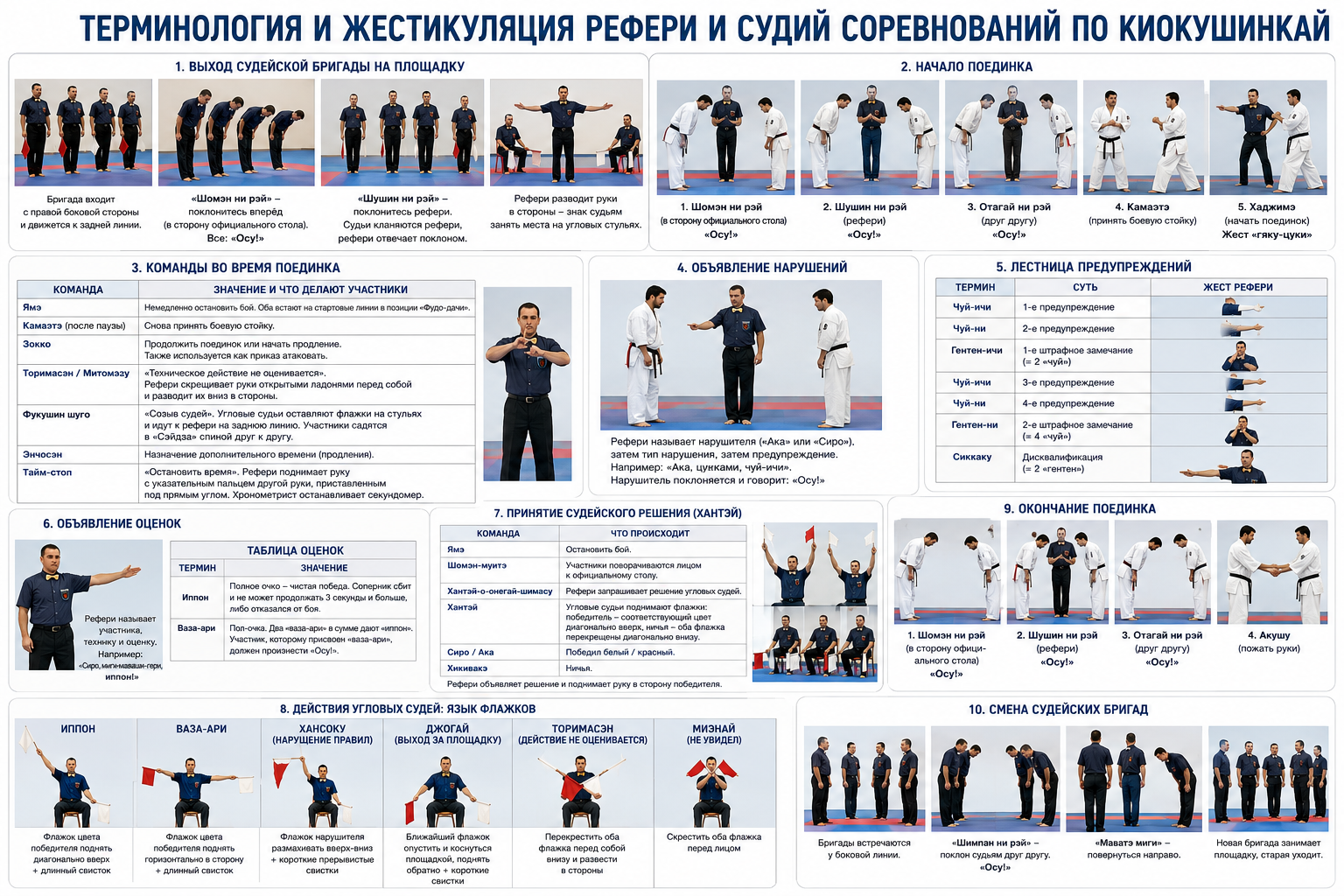
At Kyokushin tournaments, referees and judges communicate with competitors in Japanese: issuing commands, announcing scores, and calling fouls. Every word is accompanied by a gesture or a flag signal. If you understand the system, a tournament reads like a book. If you do not, it looks like an indecipherable ritual.
Below is a full breakdown of all the terminology used by referees and corner judges from the moment competitors enter the competition area to the final handshake.
The Judging Panel Enters the Competition Area
A panel consisting of the referee and four corner judges enters the competition area from the right side and moves toward the back line. The referee commands:
- «Shomen ni rei» — «Bow to the front.» All judges and the referee bow toward the official table, saying «Osu!».
- «Shushin ni rei» — «Bow to the referee.» Judges bow to the referee, who returns the bow.
Afterward the referee spreads both arms to the sides — a signal for the judges to take their seats at the corner chairs.
Starting the Bout
Competitors are called by the announcer. The white belt («shiro») stands to the left of the referee, the red belt («aka») to the right. The following commands then follow:
| Command | What happens |
|---|---|
| Shomen ni rei | Competitors bow toward the official table («Osu!») |
| Shushin ni rei | Competitors bow to the referee («Osu!») |
| Otagai ni rei | Competitors bow to each other («Osu!») |
| Kamae-te | Assume fighting stance without stepping beyond the starting lines |
| Hajime | Begin the bout — the referee makes a gyaku-zuki gesture |
Commands During the Bout
| Command | Meaning and what competitors do |
|---|---|
| Yame | Stop the fight immediately. If the referee does not give the command to continue, both competitors stand on the starting lines in «Fudo-dachi» position. |
| Kamae-te (after a pause) | Assume fighting stance again. |
| Zokko | Continue the bout or begin overtime. Also used as an instruction to attack if competitors are standing without action. |
| Torimasen / Mitomezzu | «The technique is not scored.» The referee crosses both hands open-palmed in front of the body and sweeps them downward and apart. |
| Fukushin shugo | «Call the judges.» Corner judges leave their flags on the chairs and approach the referee at the back line. Competitors sit in «Seiza» with their backs to each other. |
| Encho-sen | Overtime is declared following a draw in the main bout. |
| Time-stop | «Stop the clock.» The referee raises one hand with the index finger of the other hand placed at a right angle. The timekeeper stops the stopwatch. |
Announcing Fouls
The referee names the violator («Aka» or «Shiro»), then the type of foul, then the warning. For example: «Aka, tsukame, chui-ichi.» The violator, upon hearing the warning, must bow and say «Osu!».
| Term | Foul |
|---|---|
| Ganmen-kogeki / Ganmen | Attack to the face with the fist or elbow |
| Tsukame | Grabbing the gi or any part of the opponent’s body |
| Shotei-oshi / Shotei | Pushing the opponent with an open palm |
| Kinteki-kogeki | Kick to the groin |
| Zutsuki | Head butt |
| Other | Attacking the back, striking a downed opponent, passivity, stepping out of bounds |
The Warning Ladder
Each warning is announced with a specific referee gesture:
| Term | Meaning | Referee gesture |
|---|---|---|
| Chui-ichi | 1st warning | Points finger at the violator’s abdomen |
| Chui-ni | 2nd warning | Points finger at the violator’s abdomen |
| Genten-ichi | 1st penalty point (= 2 «chui») | Points finger at the violator’s face |
| Chui-ichi | 3rd warning | Back to the abdomen |
| Chui-ni | 4th warning | Back to the abdomen |
| Genten-ni | 2nd penalty point (= 4 «chui») | Points finger at the violator’s face |
| Shikkaku | Disqualification (= 2 «genten») | Points finger from the violator’s face toward outside the competition area |
Announcing Scores
The referee names the competitor, the technique, and the score. For example: «Shiro, migi-mawashi-geri, ippon!»
| Term | Meaning |
|---|---|
| Ippon | Full point — a decisive victory. The opponent is knocked down and cannot continue for 3 or more seconds, or has given up. |
| Waza-ari | Half-point. Two waza-ari together equal one ippon. The competitor awarded waza-ari must say «Osu!». |
Rendering the Judges’ Decision (Hantei)
If neither competitor has received an ippon or waza-ari, the winner is determined by judges’ decision. The procedure:
| Command | What happens |
|---|---|
| Yame | Stop the bout |
| Shomen-muitte | Competitors turn to face the official table |
| Hantei-o-onegai-shimasu | The referee requests the decision from the corner judges |
| Hantei | Corner judges raise flags: for the winner — the corresponding color flag raised diagonally upward with a long whistle; for a draw — both flags crossed diagonally downward |
| Shiro / Aka | White wins / Red wins |
| Hikiwake | Draw |
The referee counts the votes and announces: «Hikiwake: ichi; Shiro: ichi, ni, san; Shushin: Shiro» — victory for white with a score of 4:0. The referee then raises their hand toward the winner.
Corner Judges: The Flag Language
Each corner judge has two flags — white and red, corresponding to the competitors. The white flag is always held toward «shiro», the red toward «aka», so that the flag lines do not cross.
| Situation | Gesture and signal |
|---|---|
| Ippon | Raise the winner’s color flag diagonally upward + long whistle |
| Waza-ari | Raise the winner’s color flag horizontally to the side + long whistle |
| Hansoku (rules violation) | Wave the violator’s flag up and down + short intermittent whistles |
| Jogai (out of bounds) | Lower the nearest flag and touch the competition area with it, then raise it again + short whistles |
| Torimasen (technique not scored) | Cross both flags in front of the body below waist level and spread them apart |
| Mienai (did not see) | Cross both flags in front of the face |
End of the Bout
After announcing the winner, the referee lines up the competitors on the command «Shomen-muitte.» Then:
| Command | Action |
|---|---|
| Shomen ni rei | Both bow toward the official table («Osu!») |
| Shushin ni rei | Both bow to the referee («Osu!») |
| Otagai ni rei | Both bow to each other («Osu!») |
| Akushu | Competitors meet in the center and shake hands, then leave the competition area |
The same bowing ritual — at the start and end of every bout — is not a formality. It is a reminder that the opponent in a match is not an enemy, but a partner against whom you test yourself.
Changing the Judging Panel
If the panel changes between bouts, the outgoing and incoming panels meet at the sideline. The new referee commands «Shinpan ni rei» — all judges bow to each other. Then «Mawatte migi» — both panels turn right, the new panel takes the competition area, and the old one exits. Each judge bows with «Osu!» upon entering and leaving the area.
Comments (0)
Leave a comment
Comments are moderated and published after review