
The core philosophical idea of Kyokushin karate is that strength of body, character, and spirit comes from constantly challenging oneself and through hard work. As in many other martial arts styles, the idea is that through rigorous training self-discipline is developed The core philosophical idea of Kyokushin karate is that strength of body, character, and spirit comes from constantly challenging oneself and through hard work. As in many other martial arts styles, the idea is that through rigorous training self-discipline is developed — a discipline that can be applied to self-improvement in other areas of life.
Kyokushin strives to teach its students self-defense, but never to use force for selfish purposes. If all you need is to learn self-defense, it’s better to take a self-defense course, because Kyokushin teaches far more than just self-defense — it is an entire philosophical movement with its own etiquette, prohibitions, and a true warrior’s path toward knowing absolute truth.
The symbols of Kyokushin karate are the Kanji and the Kanku:
 Kanji — represents KyokuShinKai, where Kyoku means absolute, Shin means truth, Kai means organization — together translating as «Organization of Absolute Truth.»
 Kanku — taken from the kata of the same name, «Kanku.» In this kata the hands are raised toward the sky and joined at the thumbs and index fingers. The points of the Kanku represent the fingertips, the wide sections on either side represent the wrists, and the central circle symbolizes the depth and infinity of the sky. The circle behind the symbol represents continuity and circular movement.
Core principles of Kyokushin karate:
Dojo etiquette.
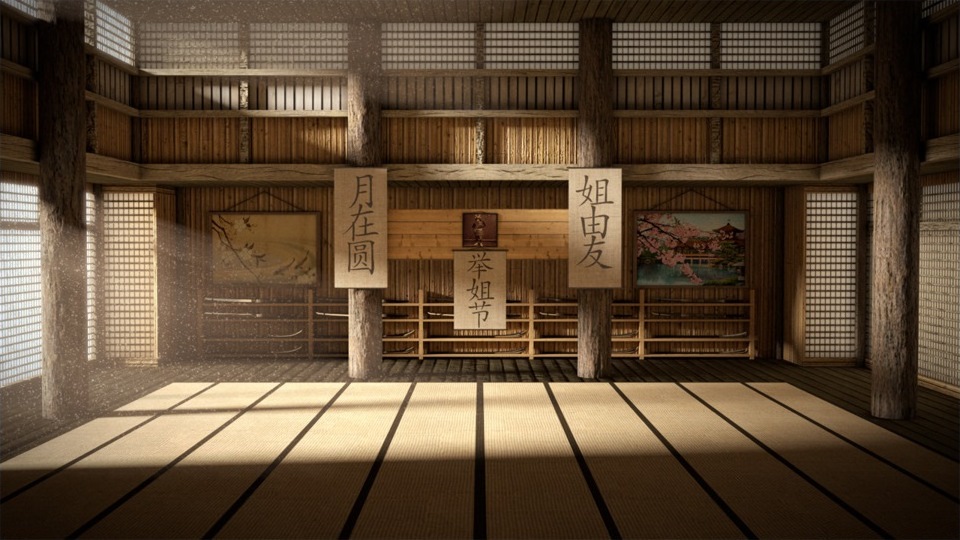
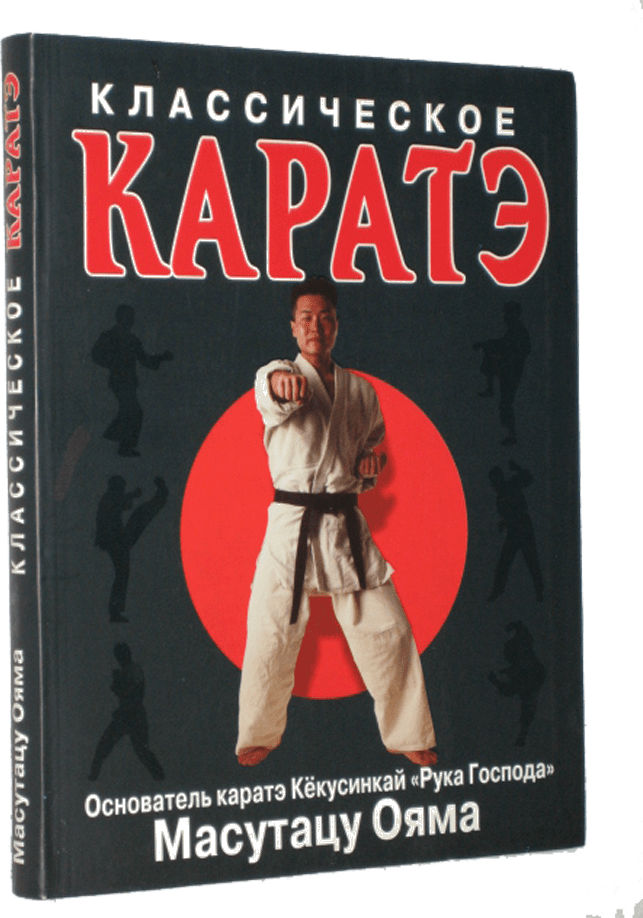
In the dojo, opposite the tatami, stands the school’s shrine — a portrait of Masutatsu Oyama, the founder of Kyokushin — to which, according to etiquette, a bow is made at the beginning and end of each training session. All schools observe dojo etiquette that regulates conduct within the school’s walls, and violations may be penalized up to demotion and expulsion from the school. With the growth of martial arts and the emergence of many organizations, dojo etiquette has become significantly simplified, but the following can be considered the core principles:
- Upon entering the dojo (training hall) and leaving it, the student must bow and say «Osu» in the direction of the school’s shrine and toward the students present in the hall;
- Students who arrive late must bow and say «Os» toward the center of the hall and sit in the «Seiza» position facing the wall opposite the school’s shrine, close their eyes and lower their head. The student must remain in this position until the instructor invites them to join the group. After the invitation, the latecomers, while remaining in «Seiza,» must bow and say shitsurei shimasu (meaning «I apologize for the inconvenience»), stand up, and without walking in front of the group, take their place at the back;
- Students must keep themselves, their uniform, and their protective gear clean. Only a clean white karate gi is permitted in training. The official symbol of Kyokushin karate — the «Kanji» — must be placed on the left side of the chest of the dogi. An untidy uniform shows a careless attitude toward training and disrespect for the dojo and its students;
- Without the instructor’s command, adjusting the dogi during training is not permitted. On the instructor’s command, to adjust the dogi one must turn their back to the school’s shrine and quickly tidy their appearance. If it is necessary to adjust the uniform without the instructor’s command, it should be done quickly on one’s own, turning away from the school’s shrine;
- All students who hold a higher rank (kyu or dan) as well as those who are older must be shown respect, and when such students enter the hall, all others must stand and say «Osu»;
- When addressing a senior student or instructor, as well as when greeting them, students must bow and say «Osu.» This ritual applies even outside the school’s walls, as students must always respect their seniors.
- When shaking hands, both hands must be used, showing trust and humility, while saying «Osu.» This ritual also applies outside the school’s walls;
- During training, students must respond immediately to commands from the instructor or a senior, saying «Osu» loudly;
- During training, students must not be distracted by unrelated topics — they must be fully focused on executing technique or completing other assigned tasks, showing the deepest respect and goodwill toward the instructor and training partners. One should never practice Kyokushin without a serious attitude — karate deserves nothing less;
- Occasionally during training, students are permitted to relax: the instructor or senior student gives the command «Anza,» after which students must take a seated position (cross-legged). During the rest period, students must sit quietly, listen to the instructor, and not be distracted by unrelated topics;
- During training, leaving the hall without the permission of the instructor or senior student is not permitted. If there is an urgent need to leave, it must be done quickly and without unnecessary commotion, and upon returning the student must inform the instructor of the reason for their absence;
- Before training, students must remove jewelry and other sharp objects to prevent injury during sessions. Glasses prescribed by a doctor are permitted during training, but must be removed during sparring or partner drills. During partner work, bag work, and kumite, it is recommended to use shin guards, hand guards, chest protectors for women, and groin protectors for men;
- It is prohibited to wear headgear, street shoes in the hall, or to use crude or profane language. Chewing gum, eating, or drinking in the hall is not permitted;
- As students must care for the training hall as a place of respect, they must clean the hall after training;
- Students must honor the fellowship of the dojo and must not harm the image of Kyokushin karate through indecent behavior outside the hall, nor show hostility toward an opponent during free sparring;
- Spreading gossip and speaking disparagingly about other Kyokushin schools or other martial arts styles is prohibited;
- Students who wish to participate in competitions and training camps must consult their instructor and obtain approval before submitting an application;
- Students who wish to visit other Kyokushin karate schools must first ask permission from their instructor. If students wish to train at other Kyokushin branches, they must have a membership card from the International Kyokushin Karate Organization and obtain a written recommendation from their instructor. While at the branch, the student must show respect, goodwill, and humility toward the branch’s students and instructors;
- In order to represent the International Organization with dignity, students must conduct themselves properly both inside and outside the dojo, and must never use force with the intent to injure another person, except in cases where the student’s life or the lives of those close to them are in danger;
- Kyokushin karate students must follow the rule: «Keep your head low (be humble), your gaze high (be ambitious), be measured in your words (be accountable for what you say) and kind in your heart (treat others with respect and goodwill). Treat your parents with reverence.»
Dojo prohibitions
- Wearing footwear inside the dojo is not permitted. Bow to the hall’s shrine and to students present when entering and leaving;
- Making noise, talking about unrelated topics, and engaging in entertainment are prohibited;
- Wearing outer clothing inside;
- Wearing headgear;
- Sitting with legs stretched out;
- Lying on the floor unless required by the instructor’s assignment;
- Eating or drinking (except in special circumstances).
Kumite etiquette
When asked to change protective gear, do so quickly, without unnecessary fuss and as quietly as possible, then immediately return to your place in the group.
If a student is missing any part of their sparring gear, they should try to borrow it from someone or check with the instructor whether an alternative activity can be done instead of sparring.
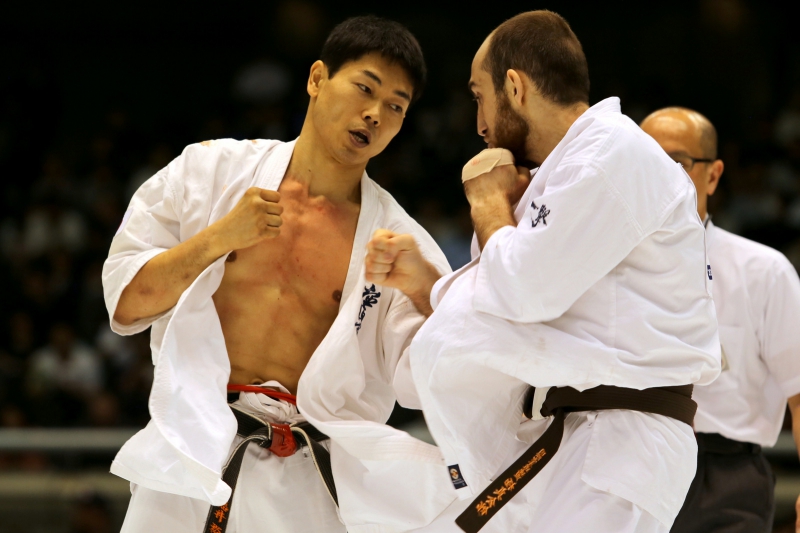
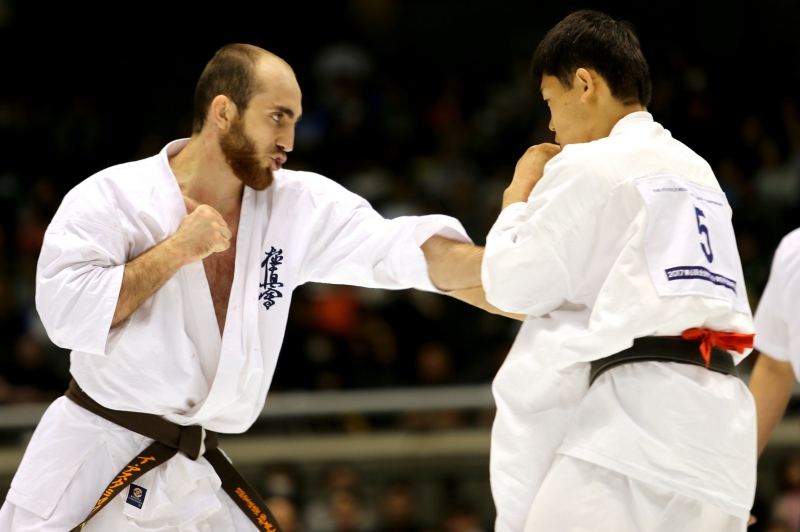
Senior students who spar with lower-ranked students must adjust their sparring style and power to match their partner’s level, since dojo sparring is not about determining who is best — its purpose is to gain experience and refine technique. If during sparring you successfully execute a technique, politely say «Osu» to your partner to show respect. In the same way, if your partner successfully executes a technique, show courtesy by saying «Osu.»
On the instructor’s command «Yame,» you must stop immediately and return to your starting position in the dojo. When joining your partner or leaving them, you must first bow in Fudo-dachi stance and say «Osu!, Arigato gozaimasu» (meaning «Osu! Thank you very much»).
The Kyokushin karate oath
- We will train our hearts and bodies for a firm, unshakable spirit. I swear!
- We will follow the true meaning of the martial way so that our senses are always ready. I swear!
- With true zeal, we will seek to cultivate the spirit of self-perfection. I swear!
- We will observe the rules of etiquette, respect for elders, and restrain from violence. I swear!
- We will follow our goals and never forget the true virtue of humility. I swear!
- We will seek wisdom and strength, desiring nothing else. I swear!
- All our lives, through karate, we will seek to fulfill the true purpose of the Kyokushin way. I swear!
Comments (0)
Leave a comment
Comments are moderated and published after review