

A karate belt holds enormous significance and special meaning for a practitioner — it is the best indicator of the effort, work, and time invested in self-improvement. The belt is the true measure of a karateka’s level of mastery!
A karate belt holds enormous significance and special meaning for a practitioner — it is the best indicator of the effort, work, and time invested in self-improvement. The belt is the true measure of a karateka’s level of mastery!
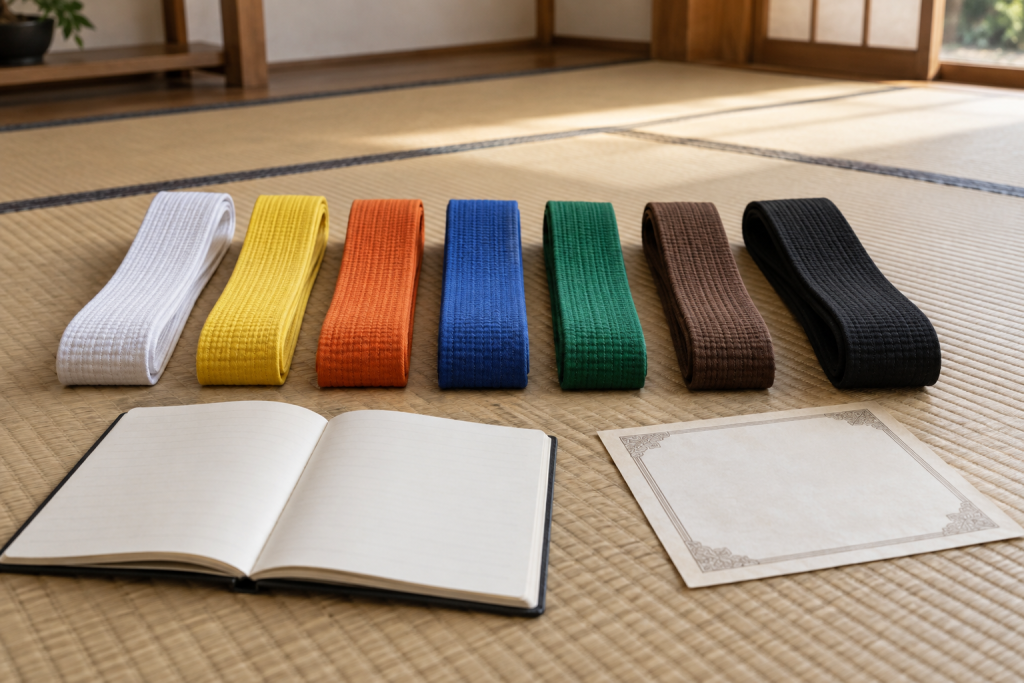
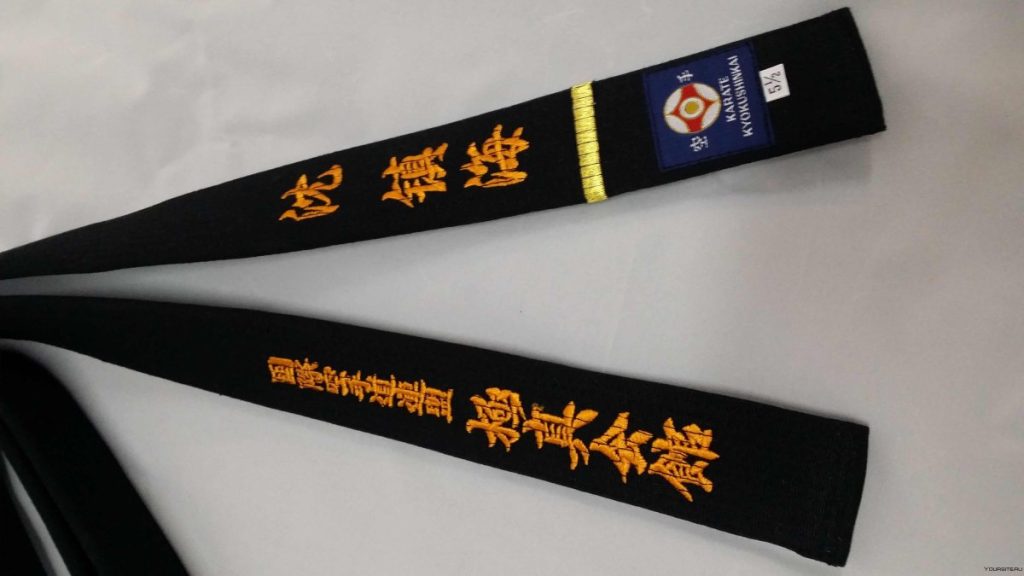
Today there are two types of rank — student ranks and master ranks, kyu and dan respectively. They differ in one key way: student belts are distinguished by color, while master belts are marked with varying numbers of gold stripes depending on level.
In the past there were only three types of belts — green and brown for students, and black for masters. Today the gradation of belts is far more varied.
So here are the Kyokushin karate belts in order, with a description of each rank.
White Belt
The white belt symbolizes purity. A student who has just entered the world of karate knows nothing about it yet. He is like a blank white sheet of paper on which the Master will write his unique story. The newcomer is bright and pure, ready to absorb every word of the instructor and learn all the subtleties of the martial art.
The white belt is a special belt, and it should be worn with pride. If the student puts in the effort, follows the master’s guidance, and trains hard, the belt will inevitably begin to change color and will eventually be so saturated with sweat and blood that it becomes black.
Orange Belt (9th-10th kyu)


This belt is the belt of stability. Its color is associated with the first streak of dawn appearing on the night sky. By the time a student is ready to test for the orange belt, they have already immersed themselves in the world of karate. They understand clearly that the path of Kyokushin is their path, and they firmly commit to walking it all the way.
The holder of this belt already has foundational knowledge and understands that karate is first and foremost about spiritual development and self-improvement. The student recognizes that further growth requires hard work, overcoming self-pity, learning to face difficulties, and never giving up in the face of setbacks.
Blue Belt (7th-8th kyu)


The level at which the student earns this belt is the level of adaptability. The color is associated with the sky just before sunrise. The yellow stripe on the blue belt represents the first ray of sunlight breaking over the horizon.
At this stage, the student not only has an understanding of movement technique, blocks, stances, and other technical elements. Their greatest achievement is self-awareness — understanding their body’s capabilities, recognizing their strengths and weaknesses, building a personal fighting strategy, and striving for excellence.
Yellow Belt (5th-6th kyu)


The yellow belt is the belt of affirmation. Yellow is no longer the first timid ray of sunlight — it is a true sunrise. The green stripe on the yellow belt represents the first seedlings breaking through the earth under the life-giving rays of the sun that give rise to all living things.
A student who has reached this stage already has sufficient skills to work on striking power and movement speed without sacrificing technique quality. The karateka has a clear understanding of their level of preparation, technical proficiency, and objectively evaluates their reaction speed in sparring — knowing which sides are strongest and which still need work.
Green Belt (3rd-4th kyu)


Green has always symbolized life. In the context of the belt, it is the level of emotions. The green belt is the first truly serious level of mastery — no longer a student rank. Earning it requires a great deal of work and effort.
The student experiments with the balance of power and speed, continues to refine kumite technique, and at this stage also develops the ability to read the opponent, execute feints, and build an individual tactical plan for each different opponent.
At this stage the main work is emotional. One must learn to conceal pain and other emotions, to be courageous, and to overcome fear. This is a critically important stage on the student’s path to mastery.
Brown Belt (1st-2nd kyu)


This color is the color of the earth, of tree bark. It is associated with maturity. And the gold stripe on it represents maturity that borders on wisdom. The brown belt is not only confident command of the body and its techniques, a harmony of power and speed — it also reflects a certain level of spiritual development and a deep understanding of the opponent. At this level of mastery there is even the capacity to conserve energy — to sense when to accelerate and when to slow down, depending on the opponent’s behavior and condition.
Holding a brown belt comes with the obligation to compete in major tournaments, not just in dojo sparring. Such a practitioner represents not only their dojo but also reflects on their Master’s reputation through their results. That is a powerful motivation to win!
Black Belt (Dan)

Receiving the black belt is a landmark event in the life of every warrior. It is a step toward new heights and new possibilities. Many students aspire to the black belt, yet in practice far from all reach this goal. And the greatest mistake is to relax. The black belt is simply the next step — but by no means the last. There are 10 dans.
Daily dedicated work on oneself will open entirely new horizons and set an example for other students.
Every belt is an indicator of mastery, a measure of self-improvement, and recognition that the effort has not been wasted. For each new kyu level it is not enough merely to demonstrate the required techniques and pass the exam — you must also prove that you are spiritually ready for the next stage.
Remember that everyone has their own path and their own timeline for progressing through the levels of mastery. Some will need less time, others much more. There is no need to rush or try to put on the next belt as quickly as possible. Remember that the belt does not make you a fighter — your spiritual development does. Walk your own path, train regularly, and the results will follow.
Comments (0)
Leave a comment
Comments are moderated and published after review